


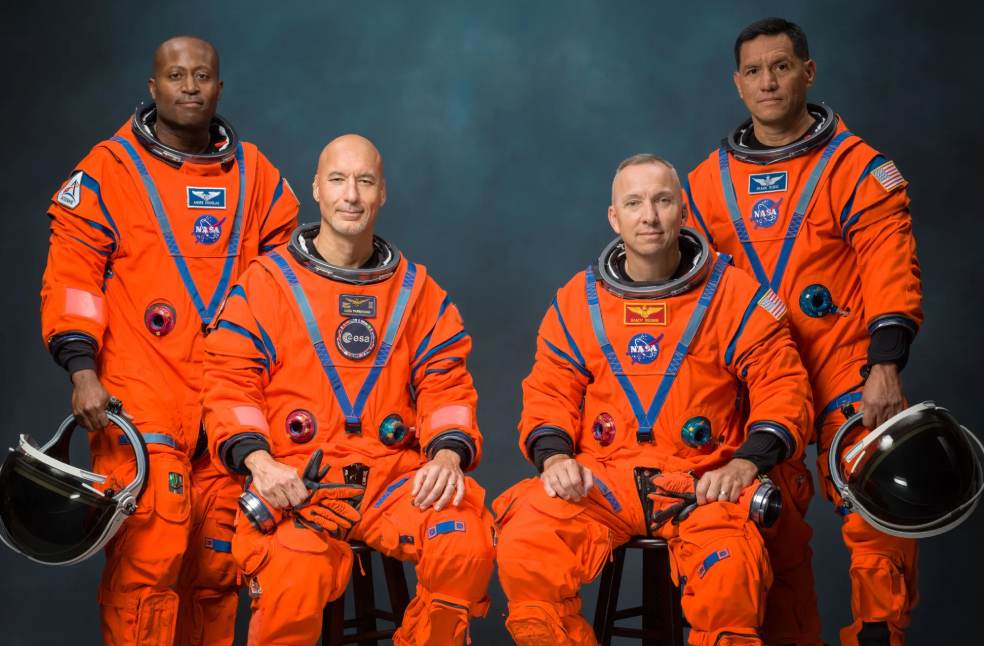
Washington: NASA has officially announced the crew selected for its Artemis III mission, a key part of the agency’s long-term effort to return humans to the Moon and eventually establish a sustained lunar presence. The mission, once intended to deliver astronauts to the lunar surface for the first crewed Moon landing since 1972, has been redesigned as a major technology demonstration in Earth orbit.
The four-member crew will be led by veteran NASA astronaut Randy Bresnik as mission commander. Italian astronaut Luca Parmitano of the Italian Space Agency will serve as pilot, while NASA astronauts Andre Douglas and Frank Rubio will act as mission specialists. Veteran astronaut Bob Heintz has been named as a backup crew member.
Although Artemis III was originally planned as a historic lunar landing mission, NASA altered the mission profile earlier this year because of delays affecting critical technologies required for future Moon landings. Instead of travelling to the Moon, the astronauts will remain in low Earth orbit and conduct docking operations with prototype lunar landers that are expected to play a central role in future Artemis missions.
“We just want to say how completely fired up we are for you.”
Artemis II crew members @Astro_Reid, @AstroVicGlover, and @Astro_Christina hand the Artemis baton to the newly-announced Artemis III crew. pic.twitter.com/nYwnHKwnqv
— NASA (@NASA) June 9, 2026
NASA officials say the mission remains one of the most complex spaceflight operations ever attempted. It will involve multiple heavy-lift rocket launches and extensive coordination between government agencies and commercial partners. The mission is intended to validate key systems and procedures before astronauts attempt to land on the Moon in later Artemis flights.
The revised mission plan comes as NASA continues to face challenges involving its commercial partners. SpaceX’s Starship spacecraft, which is expected to transport astronauts from lunar orbit to the Moon’s surface, still requires major technological milestones, including successful in-orbit refuelling demonstrations.
The programme has gained additional urgency as global competition in space exploration intensifies. China has announced plans to land astronauts on the Moon by 2030, while the United States is pushing to re-establish a human presence on the lunar surface before the end of the decade. NASA officials say Artemis III will play a crucial role in ensuring future Moon missions can be carried out safely and successfully.
MOST READ | Scientists test drug to prevent muscle loss from obesity jabs
