


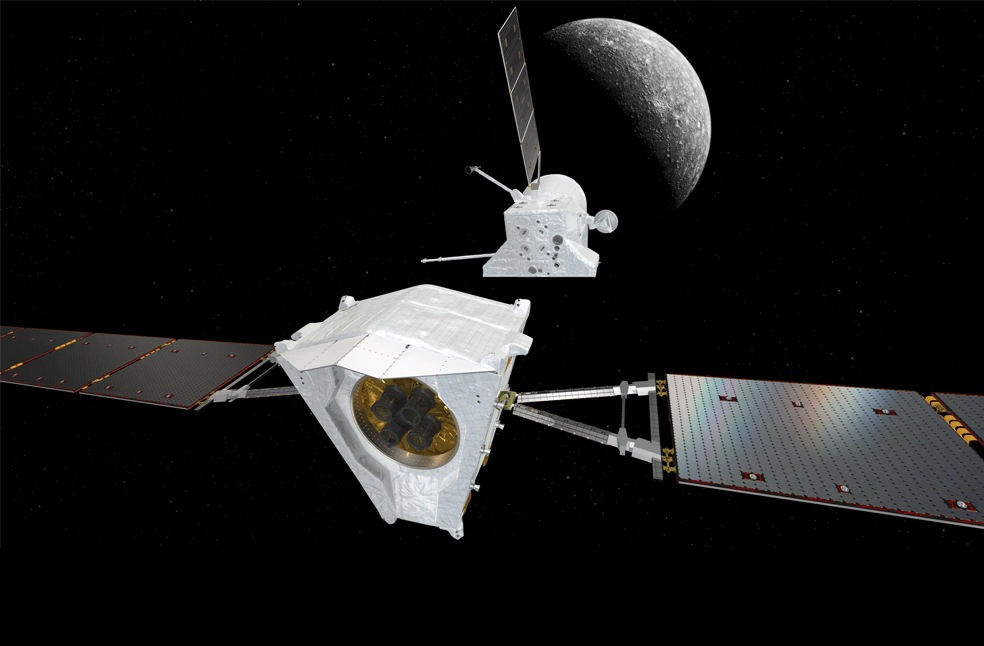
London: After travelling for more than eight years and covering approximately 6 billion miles, the joint European-Japanese BepiColombo mission has reached Mercury and is preparing to enter orbit around the smallest planet in the solar system.
The spacecraft is expected to make history as only the second mission to orbit Mercury. Flight controllers are scheduled to activate its thrusters on Saturday to place the spacecraft into orbit around the planet, which remains one of the least explored worlds in our solar system.
Valued at €1.6 billion (£1.4 billion), the mission aims to answer fundamental questions about Mercury, including how it formed so close to the Sun, why it possesses a magnetic field and the composition of frozen water deposits believed to exist inside permanently shadowed craters.
Prof Emma Bunce of the University of Leicester, who has been involved in the project for two decades, said the team was excited after years of preparation and anticipation.
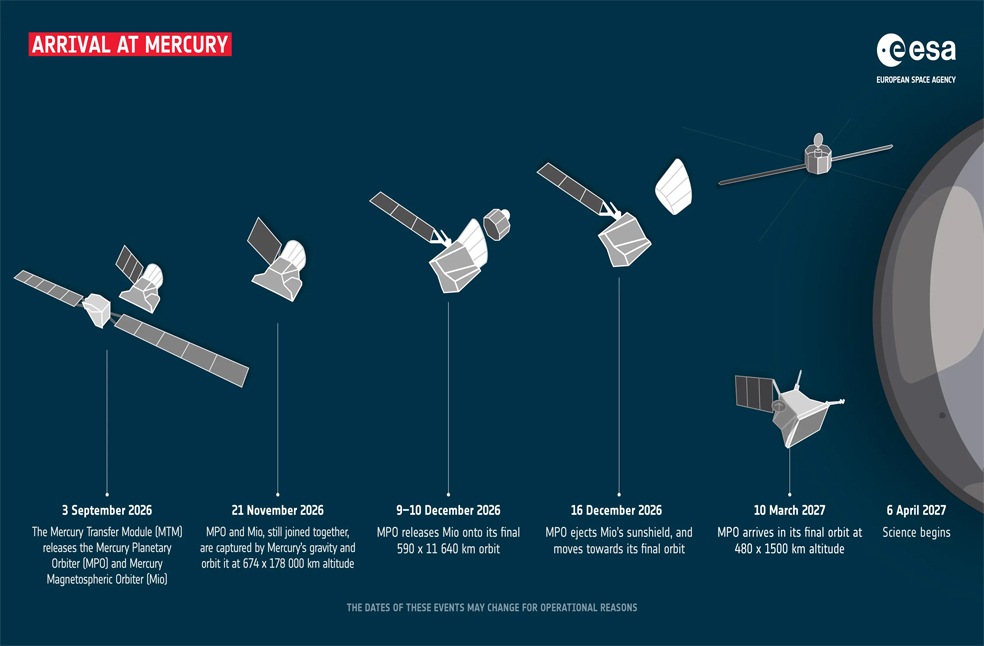
Reaching Mercury presents significant engineering challenges. The planet’s proximity to the Sun means spacecraft are pulled forward by its powerful gravitational force, requiring repeated braking manoeuvres to prevent them from passing the planet.
Bunce described the journey as particularly complex and challenging. The Prof leads the Mercury Imaging X-ray Spectrometer (MIXS), an instrument designed to examine the chemical composition of Mercury’s surface.
Scientists will have to wait several months before beginning detailed observations. In early December, the spacecraft is scheduled to separate into two orbiters, one developed by Europe and the other by Japan. Both will move into different polar orbits around Mercury, with scientific operations expected to begin in April the following year.
The European Mercury Planetary Orbiter (MPO) will produce detailed maps of the planet’s surface and composition while investigating its internal structure, particularly its unusually large core.
Meanwhile, the Japanese orbiter will examine Mercury’s magnetic field and sodium exosphere, the extremely thin layer of gas and atoms surrounding the planet.
BepiColombo’s key objective
Although Mercury is only around 50 percent larger than Earth’s Moon, it has approximately four times its mass. Understanding the reason behind its unusually high density is among the mission’s key scientific objectives.
Prof Geraint Jones, BepiColombo’s lead project scientist at the European Space Agency (ESA), stated that the prospect of significant scientific discoveries had kept the team motivated throughout the spacecraft’s eight-year journey.
Jones added that the two orbiters, equipped with advanced scientific instruments, would investigate different aspects of Mercury, including its interior, surface and surrounding space environment.
Mercury is also known for its extreme environmental conditions. It takes 58 Earth days to complete one rotation on its axis, meaning certain areas experience approximately three months of daylight followed by three months of darkness.
Located around 36 million miles from the Sun, Mercury experiences daytime surface temperatures of up to 450 degrees Celsius, while night-time temperatures can fall to minus 180 degrees Celsius.
The mission will use cameras operating across different wavelengths to examine the planet’s surface. Other instruments will analyse surrounding gases, measure its magnetic field, investigate its interior and use laser technology to map the planet’s overall shape.
BepiColombo is expected to remain in orbit around Mercury for approximately three years. Once its fuel is exhausted, the spacecraft will gradually lose altitude and eventually crash onto the planet’s surface.
ALSO READ | South Korea steps up exam checks after AI cheating scandal