


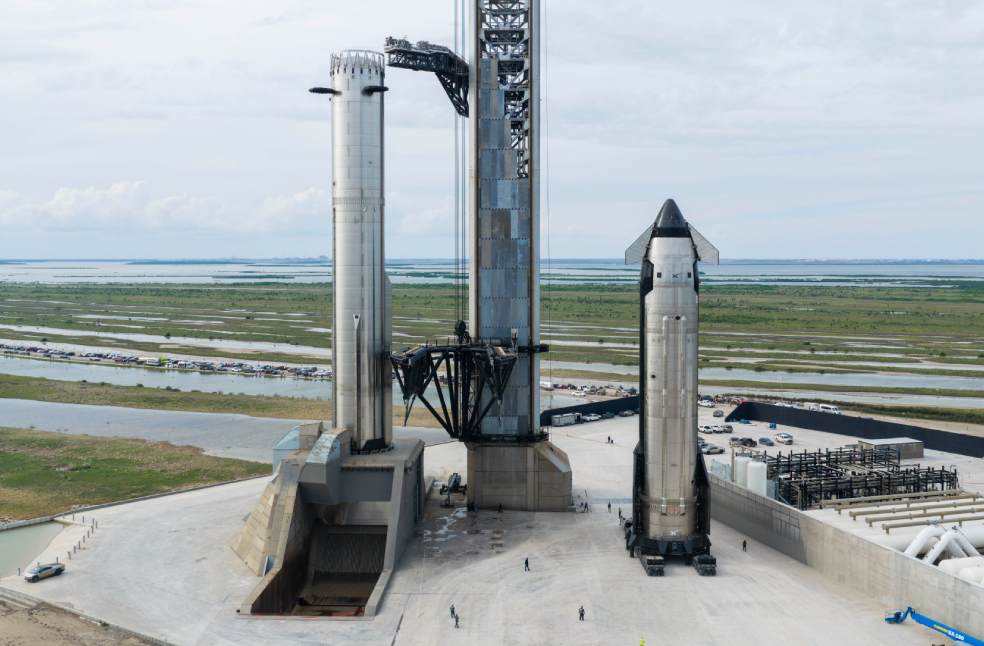
Texas: SpaceX has aborted its attempt to catch the Super Heavy booster of its massive Starship rocket during its latest test flight, diverting the returning rocket stage towards the ocean, where it burst into flames.
The mission marked another significant step in the company’s efforts to develop a fully reusable launch system capable of reducing spaceflight costs and supporting future missions to the Moon and beyond.
The 124-metre-tall Starship rocket successfully lifted off from SpaceX’s Starbase launch facility in Boca Chica, Texas, at 4:45 p.m. local time. The company had planned to recover the Super Heavy booster approximately six and a half minutes after liftoff using two giant mechanical arms, popularly known as ‘chopsticks’, attached to the launch tower. However, the recovery attempt was called off, and the booster was redirected towards the ocean.
During the launch broadcast, a SpaceX spokesperson reiterated that safety remained the company’s highest priority, particularly as it continued testing new manoeuvres and technologies. The spokesperson statedthat the company was focused on ensuring that every operation could be carried out safely.
Today, the heatshield tile that @MrBeast installed flies to space https://t.co/e5D82pYy0B
— SpaceX (@SpaceX) November 13, 2026
Meanwhile, the upper section of the rocket, known as the Ship, continued its journey into space and began deploying 26 satellites intended to join SpaceX’s Starlink constellation, which provides high-speed internet connectivity around the world. The spacecraft was scheduled to complete 14 orbits around Earth before returning approximately 22.5 hours after launch. SpaceX was expected to assess its condition in orbit before deciding whether to attempt a second recovery using the launch tower’s mechanical arms.
The company has previously demonstrated successful recovery of the Super Heavy booster during three earlier test flights. However, the upper stage has not yet been caught by the tower’s mechanical arms, having previously returned through ocean splashdowns.
SpaceX targets full rocket reusability
Developing a fully reusable rocket system has been a long-standing ambition for SpaceX. The company achieved a major milestone in 2015 when it became the first to vertically land an orbital-class rocket booster through its Falcon 9 programme. Falcon 9 rockets now conduct more than 100 flights annually, with booster reuse significantly reducing the cost of launching payloads into space.
Recovering the entire Starship vehicle could further transform the economics of space transportation. Professor Malcolm Macdonald, President of the Royal Aeronautical Society, remarked that full reusability had the potential to fundamentally change the cost of accessing space. He added that a successful flight would not establish the complete business model but could represent an important shift from demonstrating flight capability to proving how Starship could operate regularly.
The latest test flight is also attracting attention from NASA and SpaceX stakeholders, given the rocket’s importance to future lunar exploration programmes.
Starship development key to NASA’s moon mission
SpaceX has secured a NASA contract to develop a version of Starship that can serve as a lunar lander, transporting astronauts from lunar orbit to the Moon’s surface. The spacecraft is expected to play a major role in NASA’s Artemis programme, which aims to return humans to the Moon.
However, SpaceX is not the only company involved in the agency’s lunar ambitions. Blue Origin, founded by Amazon founder Jeff Bezos, is also developing a lunar landing system using its New Glenn rocket. Both companies are expected to contribute to Artemis III, a mission planned for 2027 that will involve four astronauts aboard NASA’s Orion spacecraft attempting to dock with the lunar landers developed by the two companies.
Both programmes face significant technical and scheduling challenges. Starship’s development has progressed more slowly than SpaceX initially anticipated, while Blue Origin has also experienced setbacks following a rocket explosion earlier this year that destroyed its Florida launchpad. The company’s return to flight, initially expected by the end of 2026, has been delayed until early 2027.
NASA is also facing growing pressure to maintain its lunar exploration schedule amid increasing competition from China, which aims to land astronauts on the Moon by 2030. NASA Administrator Jared Isaacman has highlighted the growing space race between the two countries, making progress in commercial launch and lunar landing technologies increasingly important to the United States.
MOST READ | Pope Leo’s visit renews hopes for Eten’s historic Eucharistic miracle