


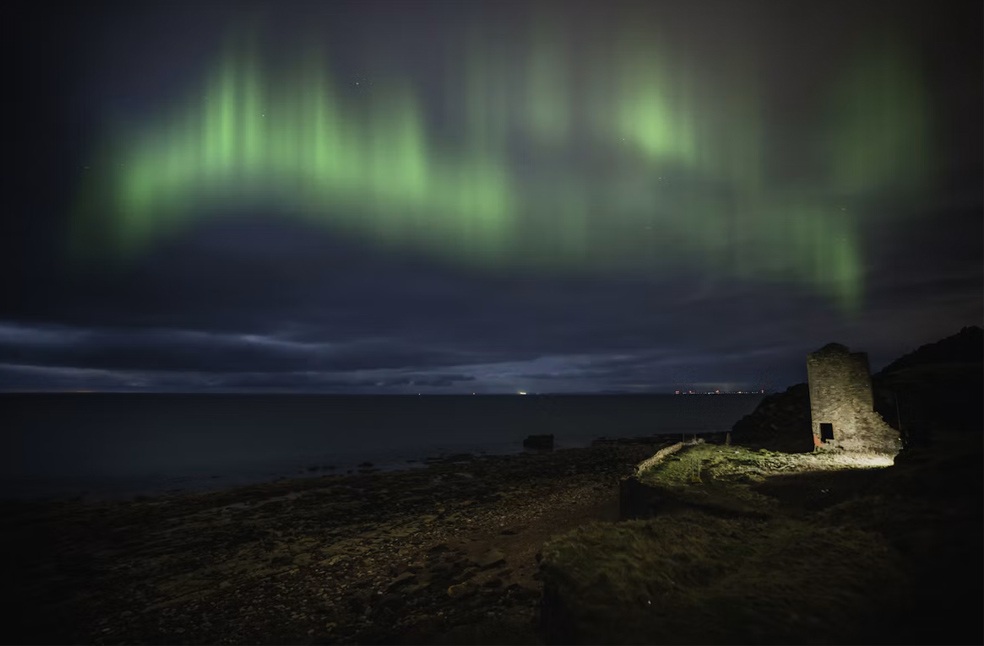
London: The northern lights lit up skies across the UK on Friday and Saturday evenings, offering sky-watchers a chance to witness the striking natural display as far south as Devon, Hampshire and Kent.
Also known as the aurora borealis, the phenomenon is typically seen in regions near the Arctic Circle and northern Scotland. However, increased solar activity and geomagnetic storms can make the colourful lights visible across wider areas.
The UK Met Office noted that further sightings could be possible until October 13, particularly across Scotland and locations at similar geomagnetic latitudes, provided skies remain clear.
The Northern Lights may be visible across parts of the north tonight 🌌
With skies clearing in places, there could be some fantastic viewing opportunities 👀 https://t.co/6NDpPoZ3rq
— Met Office (@metoffice) October 10, 2026
The aurora borealis occurs when charged particles from the Sun interact with Earth’s magnetic field and collide with gases in the upper atmosphere. These collisions release energy in the form of light, producing displays in different colours.
According to the Met Office, the Sun continuously releases charged particles known as the solar wind, which travel at speeds of around one million miles per hour. When these particles reach Earth, the planet’s magnetic field guides them towards the magnetic poles, where interactions with atmospheric gases produce the aurora.
The colours depend on the type of gas involved and the altitude at which the collisions occur. Oxygen produces green light and, at higher altitudes, rare red displays, while nitrogen can create blue and purple hues.
The increased possibility of aurora sightings comes as the Sun experiences heightened activity during its natural 11-year solar cycle. Experts previously indicated that 2026 could be a favourable year for observing the northern lights, as solar activity increases the potential for geomagnetic storms that make the phenomenon visible at lower latitudes.
ALSO READ | CJP plans march to Jantar Mantar over voter list revision
