


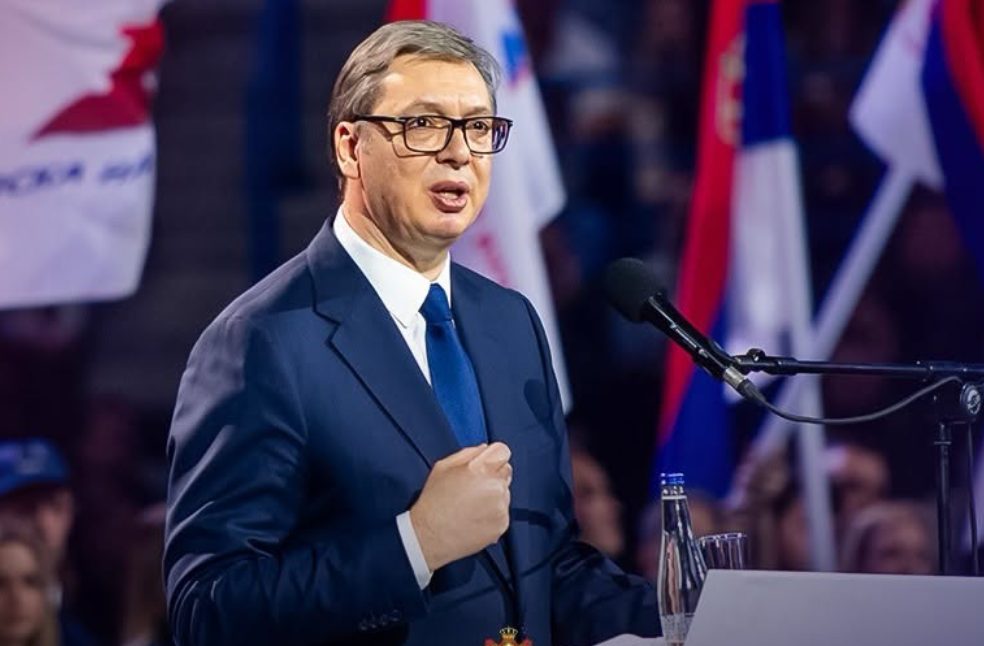
Belgrade: Serbian President Aleksandar Vucic has resigned from office to seek the prime minister’s post in a snap parliamentary election scheduled for October 25, as a student-led protest movement mounts the strongest challenge to his political dominance in more than a decade.
Vucic, who has held power as either president or prime minister since 2014, is seeking to continue his political influence through the parliamentary election after being barred from pursuing a third presidential term. Parliament Speaker Ana Brnabic, a close ally of Vucic, will serve as acting president until a new presidential election is held.
One of Vucic’s final acts as president was to pardon 49 people, including 23 individuals convicted in connection with the protests. The move comes with sustained demonstrations that have put growing pressure on the government.
Protests follow Novi Sad railway station disaster
The political crisis was fuelled by protests following the collapse of a concrete canopy at a railway station in Novi Sad on November 1, 2024, which killed 16 people. The incident triggered widespread public anger and allegations of corruption, lack of transparency and political interference in state institutions.
Student groups subsequently organised some of the largest demonstrations seen in Serbia in decades, with hundreds of thousands of people taking part in protests across the country. Vucic and his allies have rejected allegations that the government is responsible for the issues raised by demonstrators.
The student movement is contesting the parliamentary election under the banner ‘Students Win’, with support from several opposition parties, including the Democratic Party, formerly led by ex-Serbian President Boris Tadic.
The movement’s 250-candidate list largely comprises university professors and professionals from different fields. Its platform includes calls for investigations into allegedly ill-gotten property, stronger measures against corruption and political interference, and greater transparency in the management of public funds.
Some opinion polls indicate that the student-backed movement could present a significant challenge to Vucic’s Serbian Progressive Party (SNS), although the methodology and authenticity of some surveys have been questioned and are difficult to independently verify.
Concerns over Serbia’s political future
Former Serbian parliamentarian and human rights activist Aida Corovic remarked that the political tensions extend beyond the student movement, describing the country as undergoing significant internal change.
Corovic also warned that the political crisis could intensify following the October 25 election, alleging that government institutions have been heavily influenced by the ruling establishment and that links to organised crime remain a concern. These are her assessments and allegations, rather than independently established findings.
Regional impact of Serbia vote
The election is also attracting attention across the Western Balkans because of Serbia’s political, economic and cultural ties with Serbian communities in Bosnia and Herzegovina, Montenegro and Kosovo.
Tanja Topic, head of the Friedrich Ebert Foundation office in Banja Luka, a change in Serbia’s political direction could help reduce tensions in the wider region. She argued that Belgrade’s policies have at times sent mixed signals to neighbouring countries by promoting peace and stability while also contributing to regional political tensions.
The impact of Serbia’s political direction is particularly closely watched in Bosnia and Herzegovina, while relations between Serbia and Croatia have also faced tensions in recent years.
Economy remains a key issue
Serbia, with a population of around six million, is the largest country in the Western Balkans and has one of the region’s largest economies. Vucic has promoted the country as an emerging economic success story, highlighting investment from China, energy ties with Russia and expanding cooperation with Israel.
However, wage and living-standard differences with neighbouring European Union countries remain an issue. Official statistics showed Serbia’s average net monthly salary at €1,032 ($1,174) in April, compared with €1,555 ($1,770) in neighbouring Croatia.
Economic conditions and living standards are expected to remain part of the public debate as Serbian voters prepare for the snap parliamentary election.
Wartime legacy remains sensitive
Serbia’s current political tensions are unfolding alongside unresolved sensitivities surrounding the wars of the 1990s.
More than two decades ago, NATO conducted a bombing campaign against the Federal Republic of Yugoslavia during the Kosovo war, when Serbia was governed by Slobodan Milosevic. The legacy of the Balkan conflicts remains a politically sensitive issue.
In September, Ratko Mladic, the former commander of the Bosnian Serb army who was convicted of genocide and war crimes by an international tribunal, was buried in Belgrade. Several Serbian government ministers attended the funeral, which included military honours, drawing international criticism.
European Union foreign policy chief Kaja Kallas and European Commission President Ursula von der Leyen criticised the glorification of war crimes following the funeral.
The October 25 parliamentary election will therefore be closely watched for its implications for Serbia’s domestic political landscape, as well as its future relations with neighbouring countries across the Western Balkans.
MOST READ | Avanti West Coast train services to be nationalised from March
