


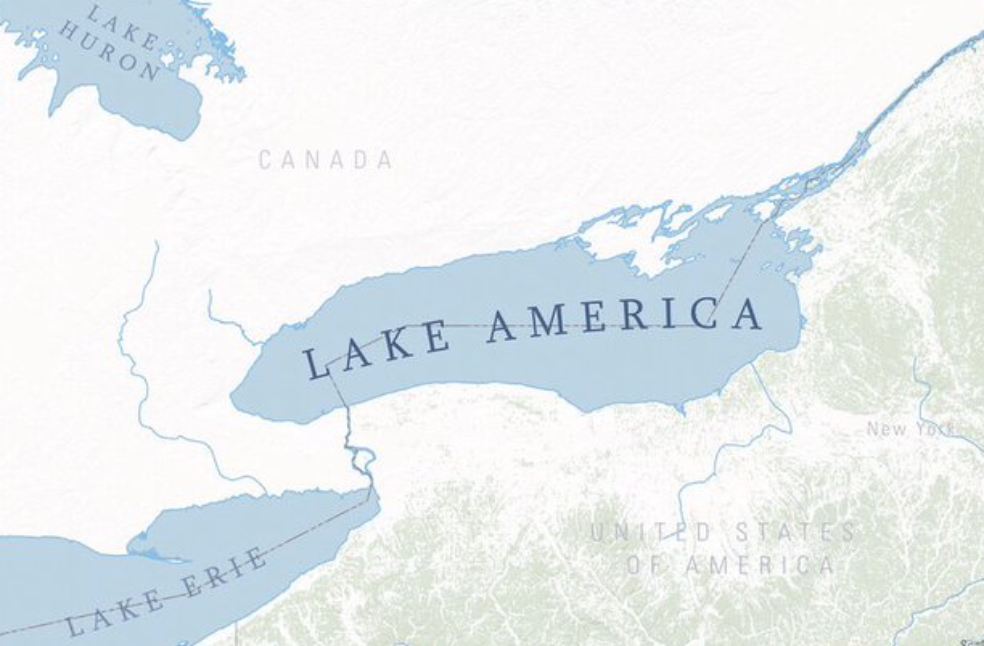
Washington: US President Donald Trump has signed an executive order seeking to rename Lake Ontario as ‘Lake America’, escalating tensions with Canada with an ongoing trade dispute between the two countries.
Trump announced the move, saying the name change was official, effective immediately and claiming that his administration had filed the necessary documents to begin the process. The proposed renaming concerns one of North America’s Great Lakes, which is shared by the United States and Canada.
The move comes days after trade negotiations between Washington and Ottawa collapsed and the US imposed new 50 percent tariffs on $20 billion worth of Canadian goods. Canada has said it will respond with dollar-for-dollar counter-tariffs next month.
⚠️ TDS TRIGGER WARNING: Lake America is officially on the map. 🇺🇸🦅
What’s next? pic.twitter.com/YCQoBXpt79
— The White House (@WhiteHouse) August 27, 2026
Under the executive order, the US Department of the Interior has 30 days to update the proposed name in the Geographic Names Information System, the US government’s official database for domestic geographic names.
Canada rejects proposed name change
Canadian Prime Minister Mark Carney firmly rejected the move, saying the body of water would continue to be known as Lake Ontario in Canada.
Carney pointed to the lake’s long history, noting that the name dates back more than 400 years and predates both the formation of the Canadian Confederation and the US Declaration of Independence.
Ontario Premier Doug Ford also dismissed the proposal, stating that Canadians and the rest of the world would continue to call it Lake Ontario. Nova Scotia Premier Tim Houston similarly criticised the move, while Industry Minister Melanie Joly said Canada would continue using the traditional name.
Trump links move to trade dispute
Trump has repeatedly raised the possibility of renaming Lake Ontario in recent social media posts amid worsening relations with Canada. While signing the order in the Oval Office, Trump said the decision was not intended as a direct message to Canada but linked it to his long-running criticism of Canadian trade policies.
Trump also joked that if the US now had a ‘Gulf’ and a ‘lake’ bearing the name America, the country might eventually consider renaming the Atlantic or Pacific oceans.
Lake Ontario is the smallest of the five Great Lakes and borders the Canadian province of Ontario and the US state of New York. Its name, like those of Lakes Huron, Michigan and Erie, has Indigenous origins.
International recognition remains uncertain
The proposed name change does not automatically mean Canada or other countries will recognise Lake America as the lake’s new international name.
There is no single universally recognised international authority responsible for naming shared bodies of water. While the US government can determine how geographic features are officially identified within its own systems, other countries are not required to adopt those names.
Trump previously took a similar step after returning to the White House by ordering the Gulf of Mexico to be renamed the ‘Gulf of America’ in US usage. Mexico rejected the change, arguing that one country cannot unilaterally rename a shared international body of water.
Google subsequently adopted different naming conventions depending on the user’s location, displaying ‘Gulf of America’ in the US and ‘Gulf of Mexico’ in Mexico.
Trade talks could still resume
Despite the latest escalation, there were signs that Washington and Ottawa could eventually return to negotiations. Canadian trade minister Dominic LeBlanc said the US had withdrawn some demands concerning French-language labelling and confirmed that measures supporting French language and Canadian culture would not be targeted by future US trade actions.
Dominic LeBlanc said further clarification from Washington on other issues could create an opportunity for a mutually beneficial agreement while respecting Canadian sovereignty.
The dispute follows the collapse of trade talks, with both sides accusing each other of seeking last-minute changes to a tentative agreement.
MOST READ | SpaceX to build $100bn starbase launch facility in Louisiana
