


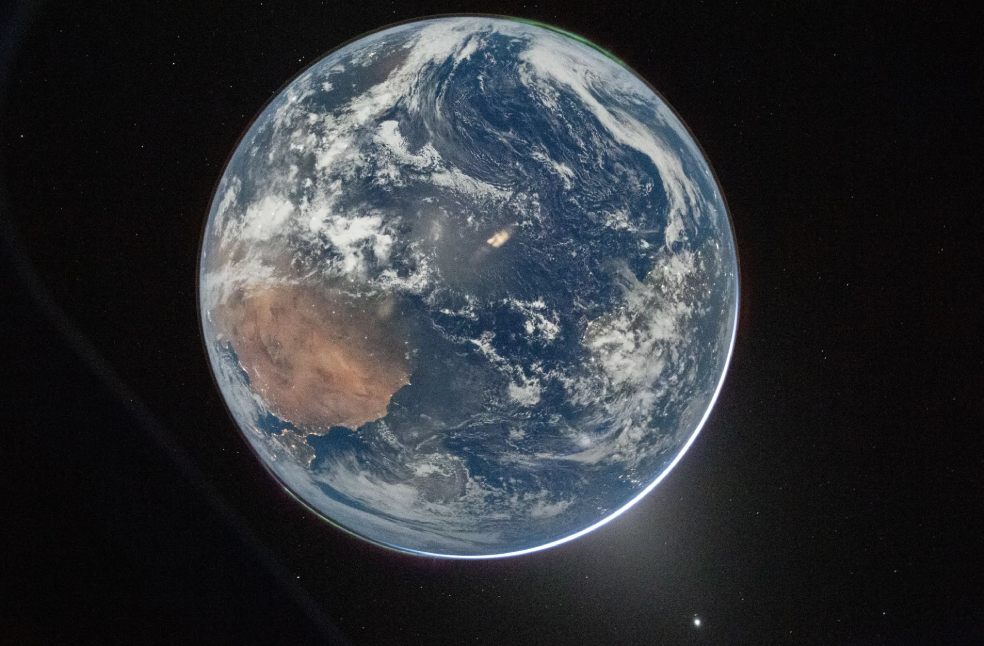
Florida: Astronauts aboard Artemis II mission have captured the first high-resolution images of Earth as they travel beyond orbit toward the Moon, marking a historic return to deep space exploration.
The images were taken by mission commander Reid Wiseman shortly after the spacecraft completed a crucial manoeuvre known as a trans-lunar injection burn. This engine burn propelled the Orion spacecraft out of Earth’s orbit and onto a trajectory toward the Moon.
One of the standout images, titled ‘Hello, World,’ reveals a vivid view of the Atlantic Ocean framed by a thin glowing layer of Earth’s atmosphere. The photograph also captures green auroras shimmering near both poles. At the same time, Earth appears inverted, with the western Sahara and Iberian Peninsula visible on one side and eastern South America on the other. A bright planet in the frame was identified by NASA as the planet Venus.
Even in darkness, we glow.
In this image of Earth taken by the Artemis II crew, we can see the electric lights of human activity. In the lower right, sunlight illuminates the limb of the planet. pic.twitter.com/kWcjHFvoDM
— NASA (@NASA) April 3, 2026
Another striking image shows Earth split between day and night along a line known as the terminator, with city lights twinkling across the darkened half of the globe. The visuals highlight both the natural beauty of the planet and the imprint of human civilisation.
The mission marks a historic return to deep space travel, becoming the first crewed journey beyond Earth’s orbit since Apollo 17 in 1972. The Artemis II crew is set to travel more than 200,000 miles, looping around the far side of the Moon before heading back to Earth.
Astronaut Jeremy Hansen described the crew’s excitement, saying they were ‘glued to the windows’ after the burn, capturing views of Earth illuminated by reflected light from the Moon. Wiseman also shared the challenges of photographing Earth from such distances, comparing it to trying to capture the Moon from one’s backyard.
The spacecraft is expected to pass around the Moon’s far side on April 6 and return to Earth by April 10, marking a major milestone in humanity’s renewed push toward lunar exploration.
In a nod to history, NASA also released a side-by-side comparison of the new images with those taken during Apollo 17, highlighting both technological advancements and the enduring beauty of Earth as seen from space.
RELATED | NASA launches Artemis II crewed Moon mission
