


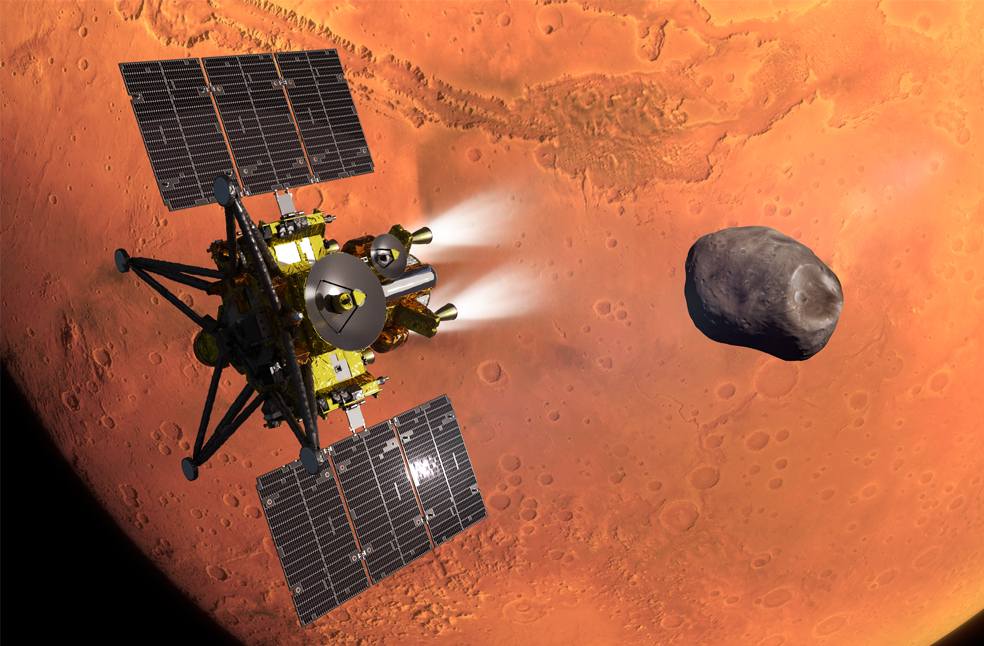
Tokyo: Japan is preparing to launch a pioneering space mission to collect samples from Phobos, one of Mars’ two moons, and return them to Earth for scientific analysis. The mission is expected to take five years and could provide new insights into how the moons formed and the early history of the solar system.
The Japan Aerospace Exploration Agency (JAXA) plans to send its Martian Moons eXploration (MMX) spacecraft aboard the H3 rocket. The international mission includes scientific instruments and communications support from NASA and other space agencies.
Scientists hope the samples will help resolve whether Phobos and its smaller companion, Deimos, formed from debris created by a major impact on Mars or are asteroids captured by the planet’s gravity.
Martian Moons eXploration (MMX) aboard the H3 Launch Vehicle No. 10 is set to launch on October 20!
Watch the launch live via the link below 🔽
https://t.co/UErHam1XcI
🎥 Activity Report Mini
#MMX #H3F10 #JAXA https://t.co/tSTDIxyYAA— JAXA(Japan Aerospace Exploration Agency) (@JAXA_en) October 18, 2026
JAXA project manager Yasuhiro Kawakatsu said the findings could also help scientists assess the potential use of a Martian moon as a base for future crewed missions to Mars. Despite decades of exploration of the Red Planet, its moons remain poorly understood. Previous Russian attempts to land on Phobos have failed.
Phobos is approximately 27 kilometres across at its widest point and orbits Mars at a distance of about 6,000 kilometres, completing three orbits each day. Scientists selected it for sampling because its proximity to Mars could provide valuable information about the planet. JAXA estimates that material originating from Mars could account for around 0.1 per cent of the collected samples.
Mission timeline and objectives
The spacecraft is expected to reach the Mars region around August 2027. It will spend approximately three years studying Phobos and collecting samples before beginning its return journey to Earth, with the return planned for 2031.
The MMX spacecraft consists of three modules dedicated to propulsion, exploration and sample return. It will carry 13 instruments, including a rover developed jointly by France and Germany, a NASA sampling device, a gamma-ray instrument and a European Space Agency deep-space communications system. A Japanese radiation monitor will also gather information relevant to future human exploration of Mars.
The French-German rover, named Idefix, is expected to land on Phobos first. During a planned 100-day mission around 2029, it will examine the surface and help identify a suitable location for the spacecraft’s sampling operation.
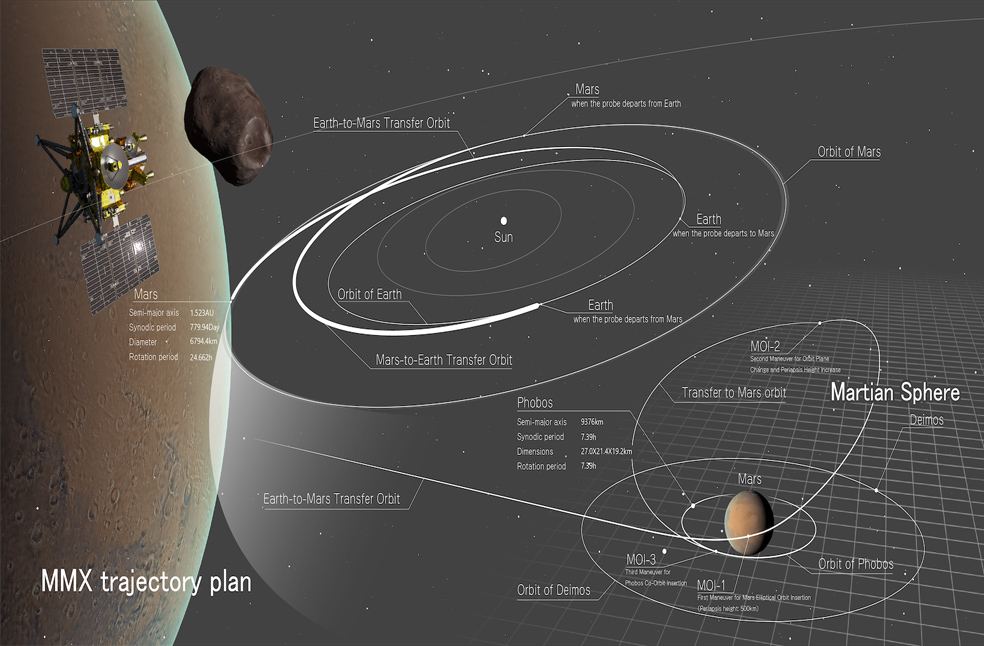
JAXA aims to collect at least 10 grams of material through two sampling attempts. NASA’s device will use pressurised gas to gather surface dust, while the Japanese system will collect material from approximately two centimetres below the surface.
The mission will obtain both surface and underground samples to improve the chances of identifying material that could reveal traces of past microbial life on Mars.
Challenges and return to Earth
Landing on Phobos presents significant technical challenges because the moon has only around one-two-thousandth of Earth’s gravity. The spacecraft’s exploration module will use shock-absorbing, four-legged landing gear to reduce bouncing during touchdown.
Idefix is designed to maintain traction on the low-gravity surface, recover if it tips over and move slowly across the terrain. After collection, the samples will be sealed in a heat-protected capsule designed to withstand the intense conditions of atmospheric re-entry.
The return module is expected to land in Australia before the samples are transported to Japan for detailed analysis. Scientists hope the findings will clarify the origins of Phobos and Deimos and provide valuable information for future Mars exploration.
MOST READ | Vaping gains ground among young UK non-smokers; Study
