


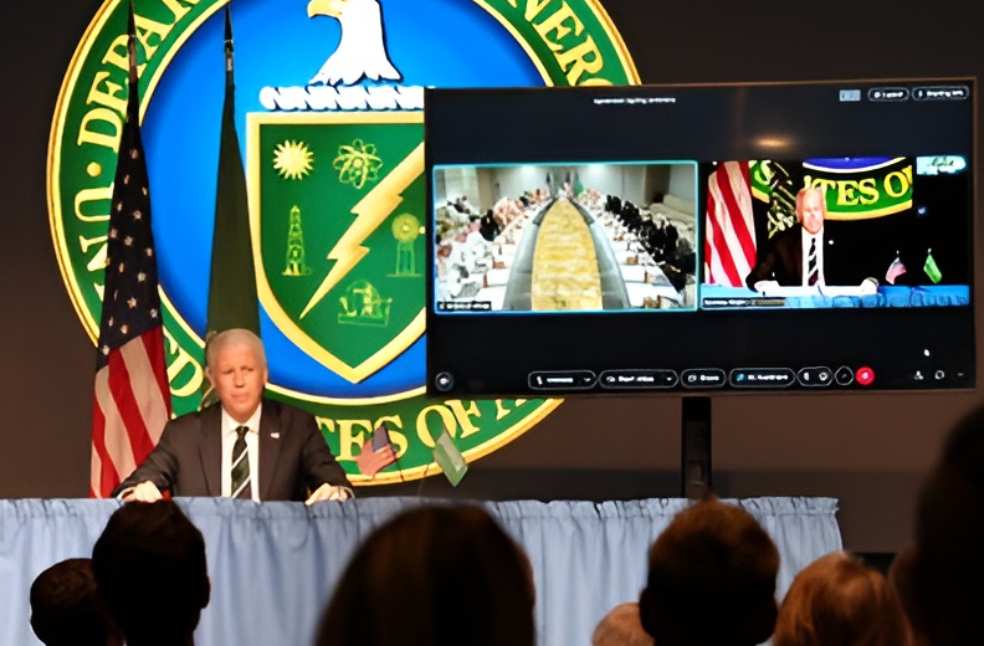
Washington: The United States and Saudi Arabia have signed a landmark civilian nuclear cooperation agreement, laying the foundation for a long-term partnership aimed at expanding the kingdom’s nuclear energy sector while strengthening strategic and economic ties between the two allies.
The agreement, described by the US Department of Energy as a ‘peaceful nuclear cooperation agreement,’ is expected to provide significant opportunities for American companies to participate in Saudi Arabia’s civilian nuclear programme. Alongside the cooperation pact, the two countries also signed a bilateral safeguards agreement, which US officials say establishes the legal framework for a multi-billion-dollar partnership focused on nuclear energy development, safety, and non-proliferation.
Although the full text of the agreement has not been released, US media reports suggest it could eventually allow Saudi Arabia to enrich uranium domestically for use as fuel in nuclear power plants. Uranium enrichment is a sensitive technology because, while it is essential for civilian nuclear energy, it can also be used to produce material for nuclear weapons if enriched to higher levels.
Today, the U.S. and Saudi Arabia announced a historic, peaceful nuclear cooperation agreement.
Thanks to President Trump, this partnership will strengthen prosperity at home and security to our allies abroad. pic.twitter.com/lUN3cFm5Et
— U.S. Department of Energy (@ENERGY) July 22, 2026
US Energy Secretary Chris Wright said the agreements uphold the highest standards of nuclear safety, security, and non-proliferation while relying on advanced American nuclear technology and expertise. The Saudi government described the agreement as an extension of the longstanding energy cooperation between the two countries, noting that it follows high-level discussions during Crown Prince Mohammed bin Salman’s visit to Washington last year.
The announcement comes with heightened regional tensions, with the United States and Iran engaged in escalating hostilities. Saudi Arabia, a key US ally that hosts several American military bases, has recently faced security threats, including attacks attributed to Iran and warnings from Yemen’s Houthi movement.
If reports regarding uranium enrichment prove accurate, the agreement would represent a significant shift in longstanding US nuclear cooperation policy.
Experts note that previous agreements, such as the 2009 civilian nuclear deal with the United Arab Emirates, prohibited domestic uranium enrichment and required imported nuclear fuel. Nuclear policy analysts have expressed concern that permitting Saudi Arabia to enrich uranium could increase future proliferation risks in the Middle East. However, US Secretary of State Marco Rubio dismissed such concerns, stating that the United States would not enter into any agreement that creates a risk of nuclear weapons proliferation.
The agreement will now be submitted to the US Congress for review, where lawmakers from both political parties are expected to closely scrutinize its provisions. Several Democratic lawmakers have already criticised the deal, arguing that it could weaken global non-proliferation efforts if enrichment rights are included.
Saudi Arabia has pursued a civilian nuclear programme for years as part of its strategy to diversify energy sources and reduce dependence on oil. Previous US administrations linked such cooperation to Saudi recognition of Israel, but reports indicate that the current agreement does not require diplomatic normalization as a precondition.
Analysts also suggest the deal reflects growing geopolitical competition, with Washington seeking to maintain its influence as Russia and China have shown interest in supporting Saudi Arabia’s nuclear ambitions. While the agreement is unlikely to alter the regional balance of power immediately, it could have significant strategic implications for the Middle East over the coming decades.
MOST READ | 12 dead after methane explosion triggers tunnel collapse in Sikkim
