


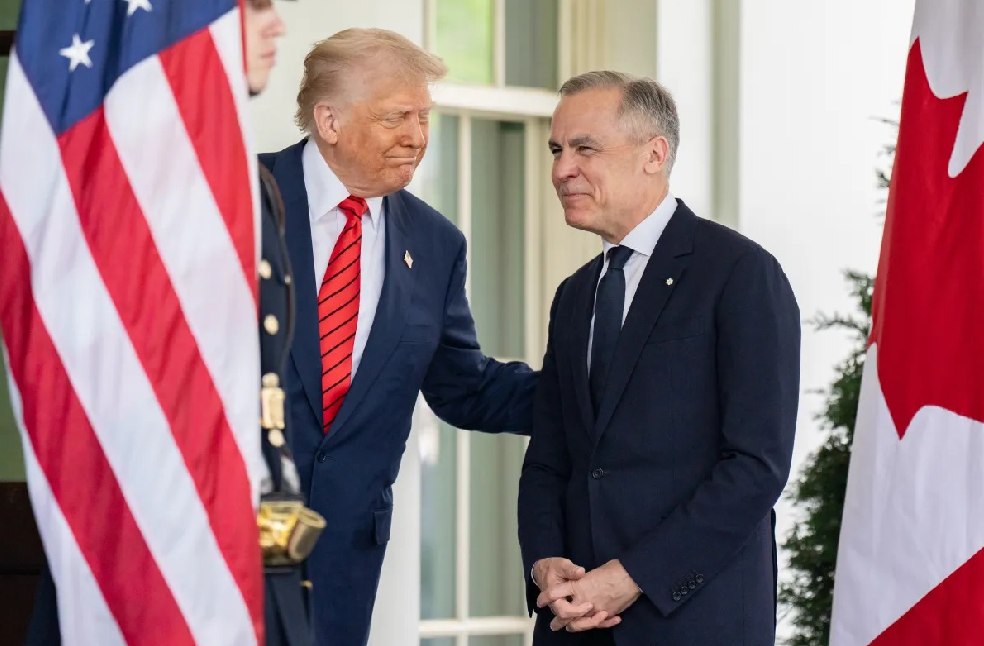
Washington: The United States has delayed planned 50 percent tariffs on Canadian exports after a last-minute agreement between President Donald Trump and Canadian Prime Minister Mark Carney.
The tariffs were due to take effect at midnight and would have covered about $20.2 billion (£14.9 billion) worth of Canadian goods. The affected products included electronics, industrial machinery, furniture, dairy products and wine.
Trump announced the breakthrough shortly before the deadline. Carney confirmed that the United States had agreed to suspend the tariffs until August 22. The United States government agreed to a 3-day pause while both sides complete documentation for the agreement. Neither Trump nor Carney has provided details of the arrangement.
My statement on ongoing Canada-U.S. trade negotiations: pic.twitter.com/rzWZJFYe8e
— Mark Carney (@MarkJCarney) August 19, 2026
Trump appeared to link the progress in negotiations to efforts to revive the Keystone XL Pipeline. The proposed project faces strong opposition and repeated delays since it was first proposed in 2008. It would transport about 830,000 barrels of crude oil a day from Alberta to Nebraska.
Former President Joe Biden revoked a key permit for the US section of the pipeline in 2021. The decision effectively ended the project on environmental and economic grounds.
The tariff delay provides welcome temporary relief for Canadian exporters who rely heavily on access to the US market. About 70 percent of Canadian exports are sent to the United States, while Canada receives about 30 percent of all US exports.
Trump announced the proposed tariffs last month through the first use of Section 338 of the Tariff Act of 1930. Washington cited what the Trump administration described as discriminatory treatment of US automobiles, dairy products and alcoholic drinks.
The measures also stood out because they would have applied to goods eligible for duty-free treatment under the United States-Mexico-Canada Agreement (USMCA). The agreement was ratified during Trump’s first administration and has kept a large share of US-Canada trade free from tariffs.
Canadian officials spents weeks in Washington seeking to prevent the measures through trade concessions. Eight of Canada’s 10 provinces have blocked sales of US-made alcoholic drinks since early last year. The restrictions were introduced in response to earlier US trade measures.
Canadian provincial leaders also shown reluctance to change the country’s supply management system for dairy, eggs and poultry. The system has been another source of concern for the Trump administration.
The temporary deal has eased immediate pressure on Canadian exporters, providing short-term certainty as businesses await further developments. However, several key trade disputes remain unresolved as negotiations between Washington and Ottawa continue.
POPULAR | South Korea rainstorm triggers deadly landslide in Geoje
