


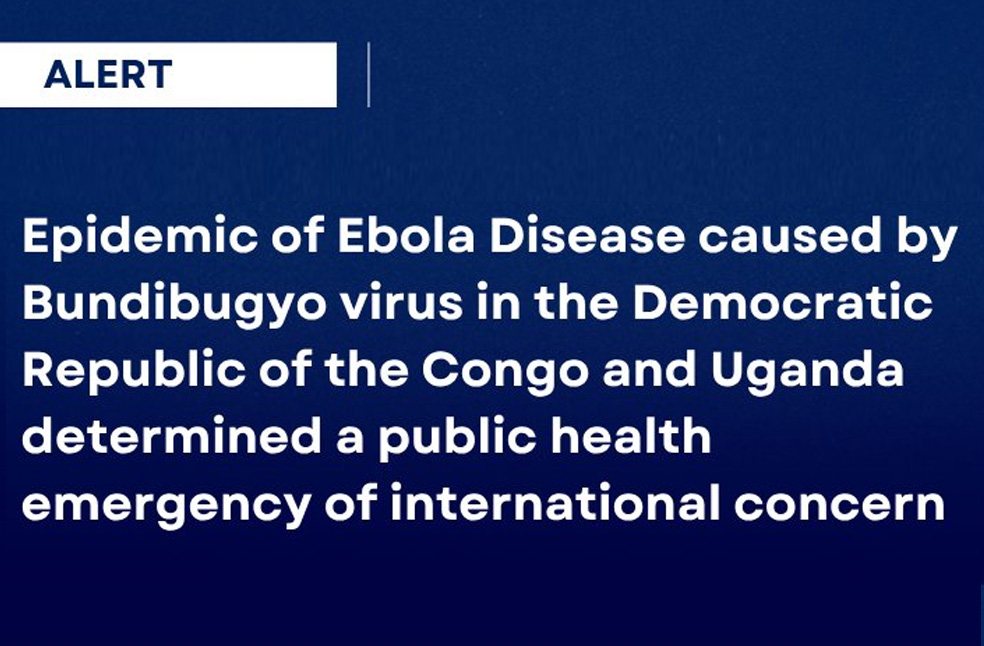
DR Congo: The World Health Organization has declared the Ebola outbreak affecting the Democratic Republic of the Congo and Uganda a “public health emergency of international concern (PHEIC).”
Despite the declaration, the UN health agency clarified that the outbreak, linked to the Bundibugyo strain of the virus, does not currently qualify as a pandemic-level emergency.
According to the WHO, as of May 16, authorities had recorded 80 suspected deaths, eight laboratory-confirmed infections, and 246 suspected Ebola cases in Ituri province in eastern DRC. The outbreak has affected at least three health zones, including Bunia, Rwampara, and Mongbwalu.
After having consulted the #DRC and #Uganda where the #Ebola disease caused by Bundibugyo virus is known to be currently occurring, I determine that the epidemic constitutes a public health emergency of international concern (PHEIC), as defined in the provisions of IHR.
My full… pic.twitter.com/zhYVEyxSI8
— Tedros Adhanom Ghebreyesus (@DrTedros) May 17, 2026
The DRC health ministry had earlier announced that 80 people had died in the outbreak in the eastern province. In Kampala, Uganda, two apparently unrelated laboratory-confirmed Ebola cases between May 15 and 16, including one death. WHO noted that both cases involved individuals travelling from the DRC.
The agency also confirmed a laboratory-detected Ebola case in Kinshasa involving a traveller returning from Ituri province. The growing spread prompted the Africa Centres for Disease Control and Prevention to warn of ‘active community transmission’ as health officials intensified screening operations and contact tracing efforts to contain the virus.
People were dying daily, and multiple burials were taking place every day, and communities still did not fully understand the illness spreading through the area. Ebola is a highly contagious disease transmitted through bodily fluids such as blood, vomit, and semen. Although rare, the disease is severe and frequently fatal.
Authorities first announced the latest outbreak in Congo after reporting 65 deaths and 246 suspected infections. During an online briefing, Africa CDC Director-General Jean Kaseya said that the earliest cases were detected in the Mongwalu health zone, a busy mining area with high movement of people.
The Director-General explained that infections later spread to the Rwampara and Bunia health zones as infected patients travelled in search of medical treatment, contributing to the spread across three health districts.
Kaseya warned that many active cases remain within communities, especially in Mongwalu, making containment and contact tracing significantly more difficult. The insecurity in Ituri province, where militants linked to the so-called Islamic State continue to carry out deadly attacks, has limited surveillance operations and slowed rapid response efforts.
The DRC has dealt with several Ebola outbreaks in the past and has developed experience in managing the disease. However, authorities continue to face major logistical challenges in delivering medical expertise and supplies across the vast country.
As Africa’s second-largest nation by land area, many Congolese provinces are separated by great distances and affected by ongoing conflict. Ituri province lies around 1,000 kilometers from Kinshasa and continues to experience violence linked to armed militant groups.
RELATED POST | Ebola outbreak in DR Congo leaves 80 people dead
