


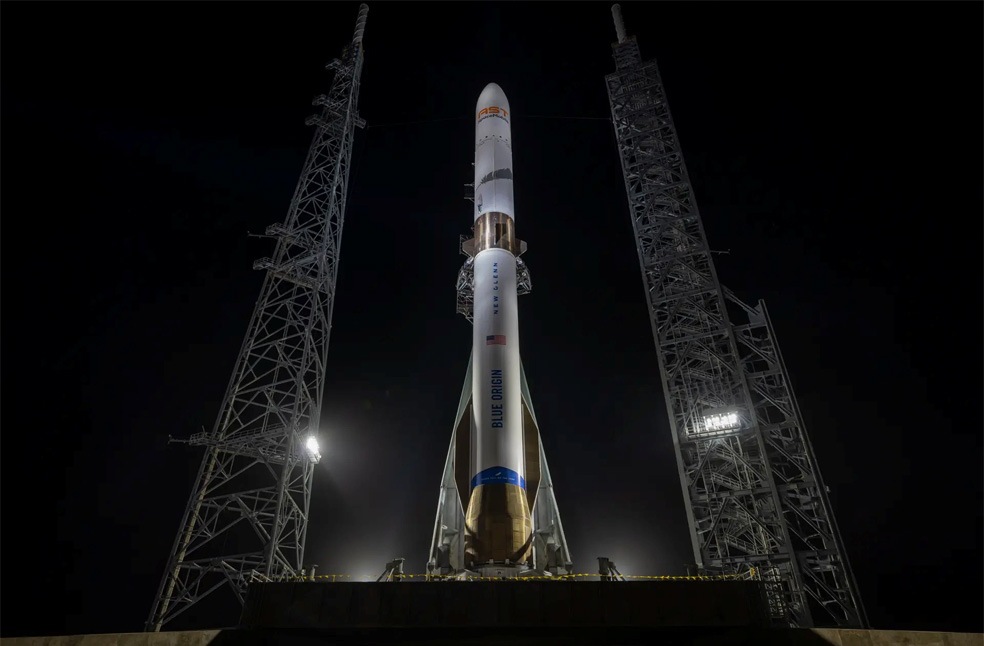
Cape Canaveral: New Glenn, developed by Blue Origin, successfully launched from Cape Canaveral, achieving a key milestone with the safe landing of its reusable booster.
However, the mission fell short of its primary objective after failing to place its communications satellite into the intended orbit. The rocket lifted off at approximately 7:25 am ET (1125 GMT), with the booster touching down around 10 minutes later.
The mission marked the third flight of New Glenn and represented a crucial step in proving its booster reusability as Blue Origin intensifies competition with SpaceX.
— Dave Limp (@davill) April 19, 2026
New Glenn carried BlueBird 7 satellite, developed by AST SpaceMobile, into low-Earth orbit. In a statement, AST confirmed that the satellite was deployed into a lower-than-planned orbit by the rocket’s upper stage. Although the satellite successfully separated from the launch vehicle and powered on, its altitude is too low to sustain operations using its onboard thruster technology, and it will eventually be deorbited.
The BlueBird 7 satellite is part of AST SpaceMobile’s effort to build a space-based cellular broadband network capable of connecting directly with smartphones. This initiative places it in competition with projects such as Amazon’s Kuiper system and SpaceX’s Starlink network.
The mission, dubbed a significant test of New Glenn’s capabilities, featured a reusable booster named ‘Never Tell Me the Odds,’ a reference to a line by Han Solo in Star Wars: The Empire Strikes Back. The booster had previously flown during the rocket’s second mission in November and was recovered, setting the stage for this latest reuse milestone.
The launch came after a series of delays and during a period of increased activity in the global space sector, including ongoing developments in NASA’s Artemis programme. Blue Origin has also announced plans to develop a larger and more powerful version of the rocket, referred to as New Glenn 9×4.
New Glenn is designed for the higher end of the commercial launch market, featuring a seven-metre (23-foot) payload fairing that allows it to carry larger and multiple payloads in a single mission.
According to company officials, the rocket has been developed with a long-term vision of supporting space operations over the next 50 to 100 years.
BlueBird 7 is the second satellite in AST SpaceMobile’s next-generation Block 2 constellation and features what the company describes as the largest commercial communications array ever deployed in low-Earth orbit. The company is currently continuing production up to BlueBird 32, with BlueBird 8 through 10 expected to be ready for shipment within approximately 30 days.
Blue Origin Vs SpaceX
The mission also underscores the growing rivalry between Blue Origin and SpaceX. Reports indicate that SpaceX has confidentially filed for a US initial public offering targeting a valuation of around $1.75 trillion. Both companies are also competing to support future lunar missions, particularly as the United States aims to return astronauts to the Moon ahead of China’s planned crewed mission by 2030.
While SpaceX is developing a Starship-based Human Landing System, Blue Origin is working on its Blue Moon lander and aims to conduct a key uncrewed lunar landing test, known as Mark 1, later this year. Upcoming Artemis missions by NASA are expected to test both lander systems in Earth orbit before a future crewed mission that would mark humanity’s return to the Moon for the first time since 1972.
Blue Origin officials reiterated that New Glenn is intended to play a central role in future deep-space exploration. Laura Maginnis, New Glenn mission vice president, stated that the rocket is designed to enable missions for NASA and other partners to travel anywhere across the solar system.
ALSO READ | Fire destroys 200 homes in Sabah; Hundreds displaced
