


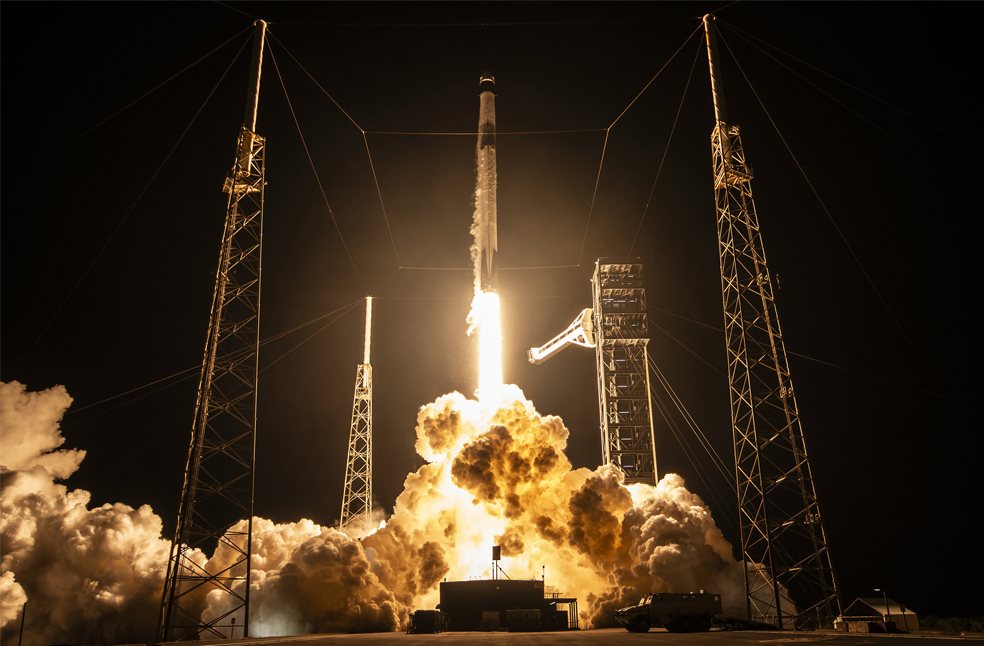
Cape Canaveral, Florida: A SpaceX Falcon 9 rocket roared into orbit from Florida, carrying two US astronauts, a French astronaut and a Russian cosmonaut on an eight-month science mission aboard the International Space Station (ISS).
The two-stage Falcon 9, topped with the autonomous Crew Dragon capsule named ‘Freedom,’ lifted off at approximately 5:15 a.m. EST (1015 GMT) from Cape Canaveral Space Force Station on Florida’s Atlantic coast.
A live joint webcast by NASA and SpaceX showed the 25-storey rocket ascending from the launch pad as its nine Merlin engines ignited, consuming roughly 700,000 gallons of fuel per second and producing thick vapor clouds and a reddish fireball that illuminated the pre-dawn sky.
The Nasdaq Tower lights up today for @NASA's SpaceX Crew-12 Mission—the latest Commercial Crew rotation to the International Space Station (@Space_Station) to advance research and technology for future Moon and Mars missions. pic.twitter.com/zF7GUWQmOz
— Nasdaq (@Nasdaq) February 13, 2026
Nine minutes after liftoff, the Falcon 9’s upper stage had accelerated beyond 17,000 miles per hour (27,360 kph), successfully placing the Crew Dragon into orbit. Meanwhile, the reusable first-stage booster performed a controlled descent and landed safely at Cape Canaveral.
The four astronauts are scheduled to dock with the ISS on February 14 afternoon following a 34-hour journey, reaching the orbiting laboratory approximately 250 miles (420 km) above Earth.
Designated Crew-12, the mission marks NASA’s 12th long-duration ISS crew rotation launched aboard a SpaceX rocket since the private company, founded in 2002 by billionaire Elon Musk, began transporting US astronauts to orbit in May 2020.
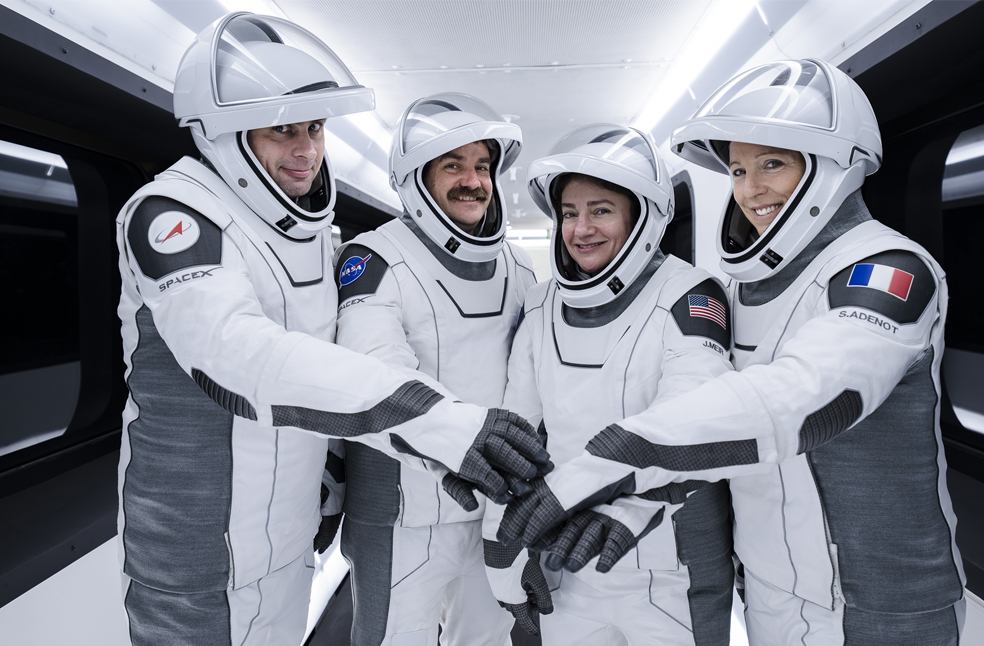
The mission is commanded by NASA astronaut Jessica Meir, 48, a veteran spacefarer and marine biologist making her second ISS journey. Nearly seven years ago, Meir and fellow NASA astronaut Christina Koch conducted the first all-female spacewalk in history.
Shortly after launch, Meir radioed SpaceX’s flight control center near Los Angeles, saying: “Thank you team, that was quite a ride. Crew-12 is grateful and ready for the journey ahead. We’re on our way.”
Joining her are NASA rookie astronaut Jack Hathaway, 43, a former US Navy fighter pilot; European Space Agency astronaut Sophie Adenot, 43, a French master helicopter pilot; and Russian cosmonaut Andrey Fedyaev, a former military pilot on his second ISS mission.
Once aboard the ISS, the team will carry out a wide array of scientific, medical and technological research in microgravity. Experiments include studies of pneumonia-causing bacteria aimed at improving treatments on Earth, and research into plant and nitrogen-fixing microbe interactions to advance space-based food production.
Many of the investigations are designed to refine technologies and systems for NASA’s Artemis program, the agency’s successor to Apollo, which seeks to return astronauts to the moon and eventually send humans to Mars.
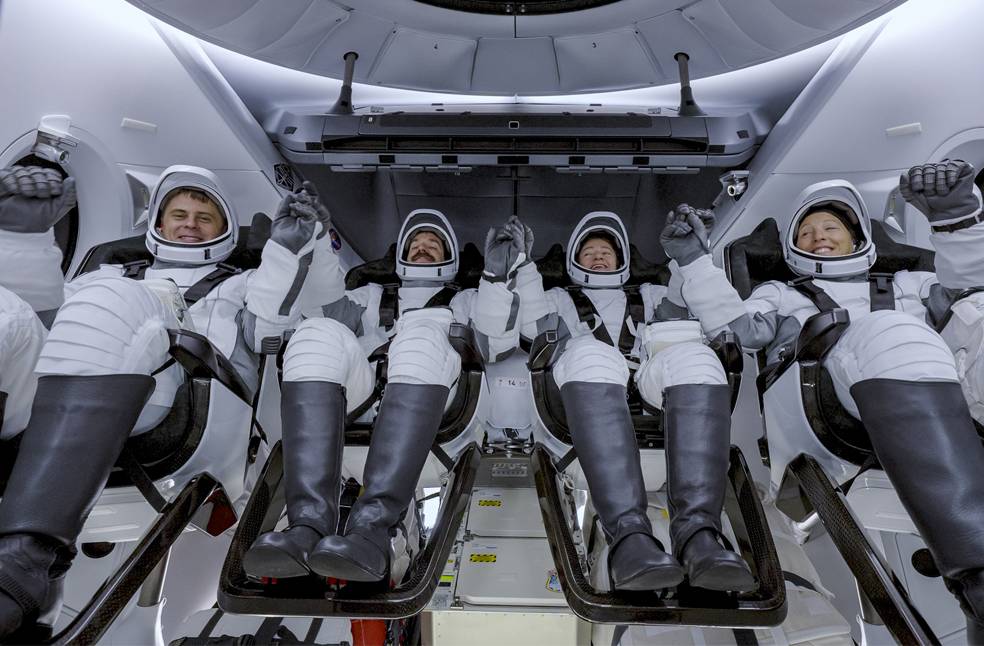
The Artemis II mission, a 10-day test flight planned to carry four astronauts around the moon and back, could launch as early as next month. Crew-12 will be greeted by three current ISS residents: NASA astronaut Chris Williams and Roscosmos cosmonauts Sergey Kud-Sverchkov and Sergei Mikaev.
Their arrival follows the early departure of four Crew-11 astronauts, who returned to Earth weeks ahead of schedule after an undisclosed serious health condition affecting one crew member prompted an unprecedented medical evacuation flight in mid-January.
The ISS, spanning the length of a football field, is the largest human-made structure in space. The station has been continuously inhabited for more than two decades under a US-Russian-led partnership that also includes Canada, Japan and 11 European nations.
Conceived after the collapse of the Soviet Union to strengthen cooperation between Washington and Moscow following the Cold War-era space race of the 1950s and 1960s, the orbiting outpost remains a cornerstone of international collaboration in space. NASA has pledged to keep the ISS operational through at least 2030.
ALSO READ | Swimwear restrictions rolled out on Sydney’s beachside bus
