



Washington DC: People across the globe are living better lives and expressing more hope for the future, as global life satisfaction reaches a record high, according to a new Gallup survey.
Gallup’s data, based on responses from 142 countries in 2024, shows that a median of 33 percent of adults rated their lives positively enough to be considered thriving. This marks a two-percentage-point increase from 2023. In contrast, only 7 percent of adults were categorized as ‘suffering,’ a figure that has declined from the 12 percent low point recorded in 2014.
These findings continue a nearly two-decade trend of rising global life satisfaction since Gallup began conducting this annual survey. Back in 2008, amid the aftermath of the global financial crisis, only 20 percent of respondents worldwide were considered thriving.
Commenting on the findings, Benedict Vigers, Senior Global News Writer at Gallup, noted that, “The world is not short of significant challenges, from climate change to conflicts and technological upheaval. Yet even against this backdrop, more people across more countries say they are living better lives today and are hopeful for tomorrow, and fewer are suffering.”
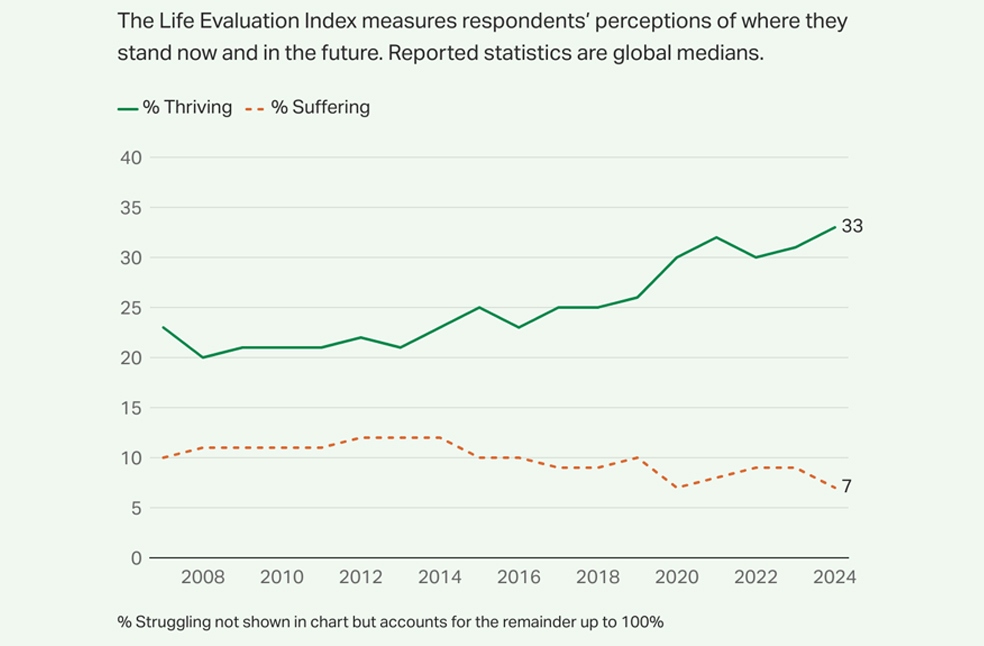
Gallup’s survey revealed regional disparities in life satisfaction. Northern Europe reported the highest median percentage of adults classified as thriving, at 66 percent.
This was followed by North America and Australia, and New Zealand, all with medians of 49 percent. In contrast, South Asia reported the lowest regional satisfaction, with a median of 11 percent, followed by sub-Saharan Africa at 15 percent, and the Middle East and North Africa (MENA) region at 17 percent.
Over the past ten years, twelve countries have seen an increase of 20 percentage points or more in their population classified as thriving. These countries include Bosnia and Herzegovina, Slovenia, Lithuania, Estonia, and Hungary, among others.
Gallup also stated that these changes reflect steady improvements captured in the United Nations Human Development Index (HDI), which tracks quality-of-life metrics such as life expectancy and income.
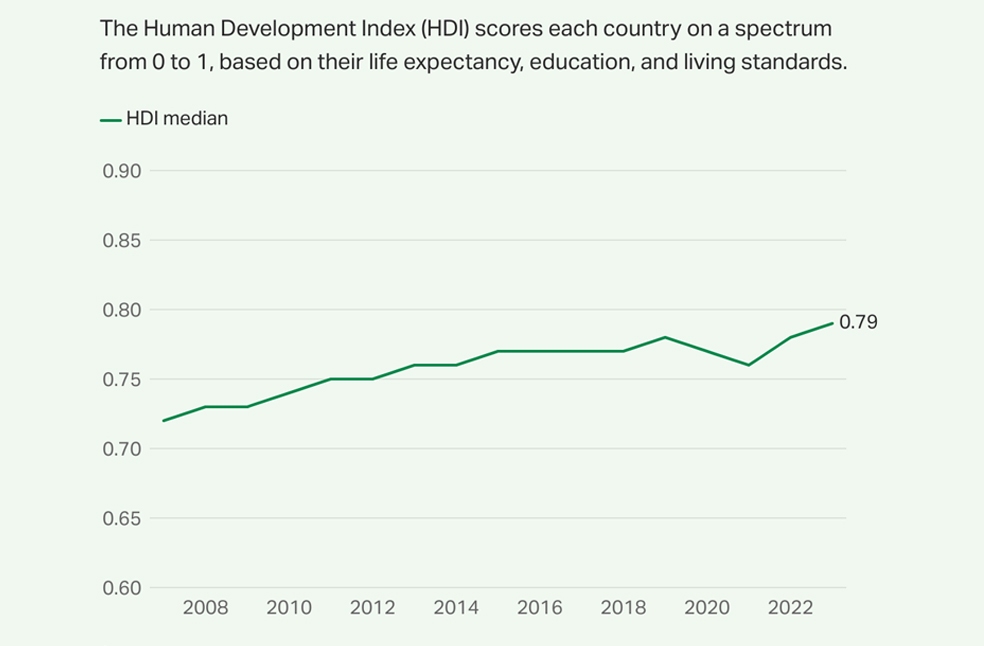
However, the polling agency pointed out that countries showing the greatest progress on such metrics did not always experience the most significant increases in subjective well-being.
To assess perceptions of life satisfaction, Gallup asked respondents to rate their current lives and future expectations using a scale from 0 to 10. Individuals who rated their present life at seven or above, and their expected life in five years at eight or above, were classified as ‘thriving.’ Those who gave scores of four or lower were categorized as ‘suffering.’
The rest of the population, those whose ratings fell between those ranges, were considered to be ‘struggling,’ though Gallup’s latest release focused on the shifts in the thriving and suffering categories.
The report arrives amid complex global circumstances, including ongoing conflicts, economic fluctuations, climate-related concerns, and technological disruptions, but suggests that overall life satisfaction is rising globally, and hope for the future remains strong among many.
ALSO READ | UK launches campaign to tackle surge in knife crimes
