


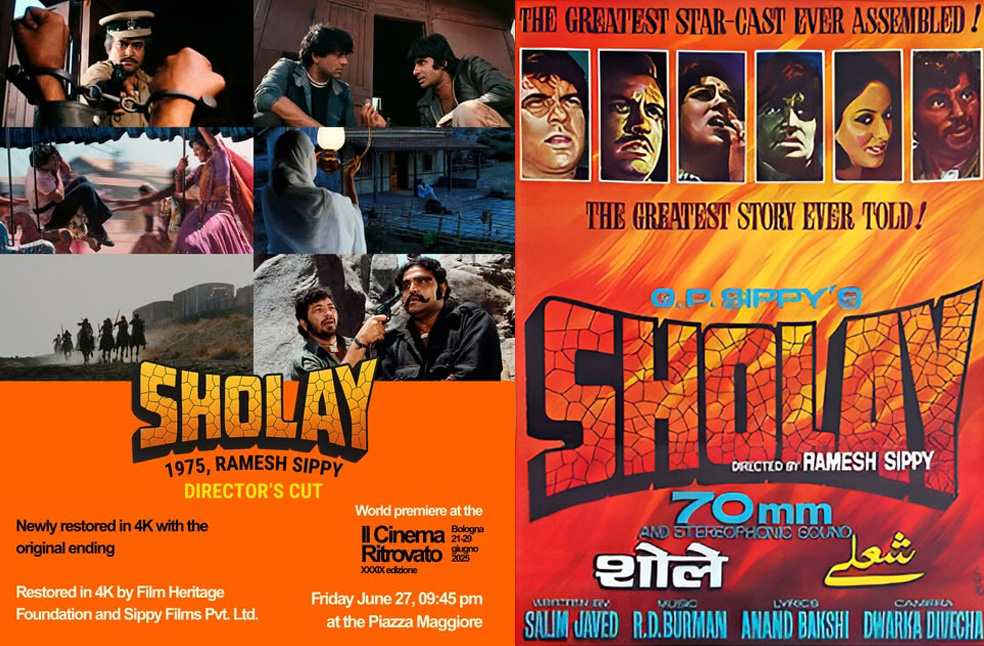
Bologna, Italy: Fifty years after it first set Indian cinema screens ablaze, Sholay, widely regarded as the most iconic Hindi film of all time, is returning in its most complete form ever.
The fully restored and uncut version of Ramesh Sippy’s 1975 epic will make its world premiere at the Il Cinema Ritrovato Festival in Bologna, Italy, this Friday, in what is being hailed as a landmark event for film lovers worldwide.
This version, unlike any screened before, includes the film’s original ending, where the villain Gabbar Singh is killed by Thakur Baldev Singh, as well as never-before-seen deleted scenes.
The original ending had been altered following objections from Indian censors, who found the film’s stylized violence excessive and disapproved of a former police officer enacting vigilante justice. These concerns were heightened as the film was released during the Emergency, a period of suspended civil liberties under India’s Congress-led government.
With the censors refusing clearance, Sippy was forced to reshoot the climax, softening it so that Gabbar is captured rather than killed. The crew returned to Ramanagaram’s rugged landscapes, reimagined on screen as the fictional village of Ramgarh, to complete the new ending and gain final approval.
The restored version of Sholay will be screened on the open-air screen at Bologna’s historic Piazza Maggiore, one of Europe’s largest, creating a dramatic and fitting setting for the film’s resurrection. The restoration is described by Shivendra Singh Dungarpur of the Film Heritage Foundation as the most faithful version of the film ever presented.
Written by legendary screenwriters Salim-Javed, the 204-minute film stars cinematic giants Amitabh Bachchan, Dharmendra, Hema Malini, Jaya Bhaduri, Sanjeev Kumar, and Amjad Khan, whose portrayal of the bandit Gabbar Singh became one of the most iconic villains in Indian film history.
Drawing influence from Westerns and samurai films, Sholay tells a classic good-versus-evil story. It follows Jai and Veeru, two small-time criminals hired by retired jailer Thakur to capture Gabbar, who terrorizes the peaceful village of Ramgarh.
Silent screenings to packed theatres
Though its release was rocky, with delayed prints, harsh early reviews, and a muted audience reaction, Sholay eventually became a cinematic and cultural phenomenon. Early screenings were marked by silence from audiences, and critics were scathing.
By the third week, audiences began quoting lines, and by the time Polydor released a 48-minute LP of the film’s dialogues, it was clear the film had struck a deep chord. Half a million records and cassettes of R.D. Burman’s music and the film’s lines were sold.
The film ran for over five years at Mumbai’s Minerva theatre, three years in regular shows and two more as matinees. Even in its 240th week, screenings remained packed.
It was later voted ‘Film of the Millennium’ in a BBC India poll and named the greatest Indian film in a British Film Institute survey. In 2015, Sholay was released in Pakistan and, despite being four decades old, outperformed several Indian films released over the previous decade, including Devdas (2002).
Restoration of Sholay
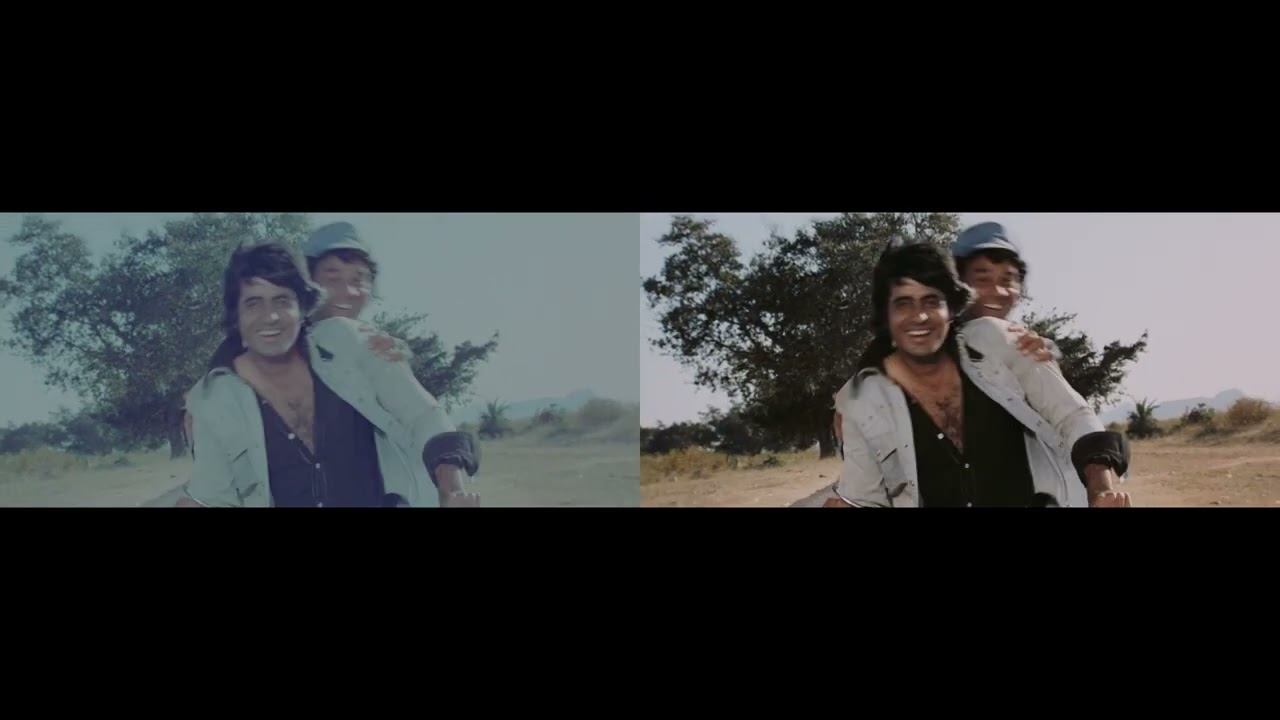
The restoration process took three years and was far from simple. The original 70mm prints no longer existed, and the surviving negatives were badly damaged. In 2022, Ramesh Sippy’s son, Shehzad Sippy, contacted the Mumbai-based Film Heritage Foundation to discuss the possibility of restoring the film.
What seemed like a long shot turned out to be a miracle: stored in unlabeled cans in a Mumbai warehouse were the original 35mm camera and sound negatives. Additional film elements were located in the UK, and with help from the British Film Institute, the reels were transferred to L’Immagine Ritrovata in Bologna, one of the world’s most renowned film restoration facilities. The original camera used for filming was also recovered during the process.
Beyond its cinematic impact, Sholay has embedded itself into Indian pop culture. Its dialogues are referenced at weddings, spoofed in advertisements, and quoted in political speeches. Characters like Basanti, played by Hema Malini, and the terrifying yet oddly endearing Gabbar Singh, played by Amjad Khan, are now part of India’s cultural lexicon. Film distributor Shyam Shroff famously said of the film: “As they used to say about the British Empire, the sun never sets on Sholay.”
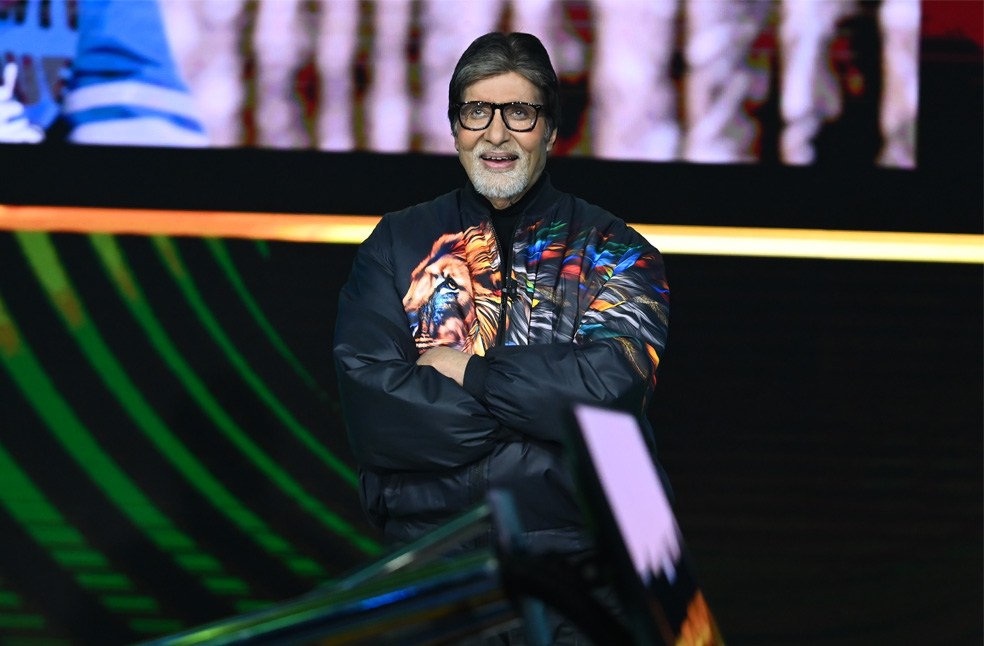
Reflecting on its enduring popularity, Amitabh Bachchan said that while shooting Sholay was an unforgettable experience, he had no idea at the time that it would become a defining moment in Indian cinematic history.
Asked why Sholay continues to resonate with audiences half a century later, Bachchan offered a simple explanation: “The victory of good over evil and… most importantly, poetic justice in three hours! You and I shall not get it in a lifetime.”
ALSO READ | NASA gears up for Axiom Mission 4 launch to ISS
