


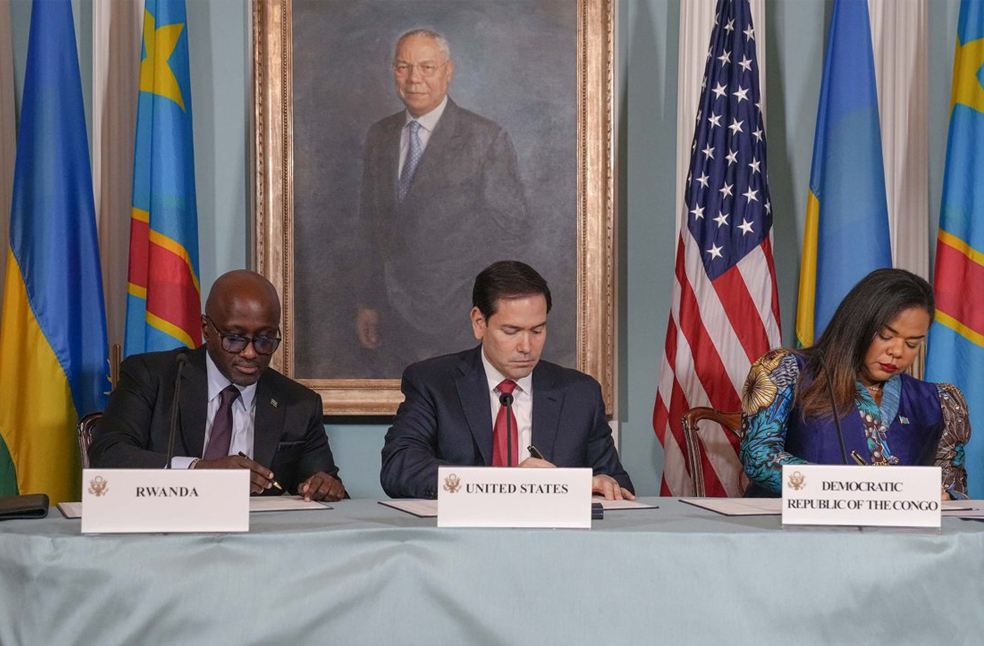
Washington DC: Rwanda and the Democratic Republic of Congo (DR Congo) have signed a significant US-brokered peace deal in Washington, aimed at resolving decades of violent conflict between the two neighboring countries.
The agreement, while light on details, calls for the ‘disengagement, disarmament, and conditional integration’ of armed groups operating in eastern DR Congo, an area long plagued by instability, displacement, and resource-fueled violence.
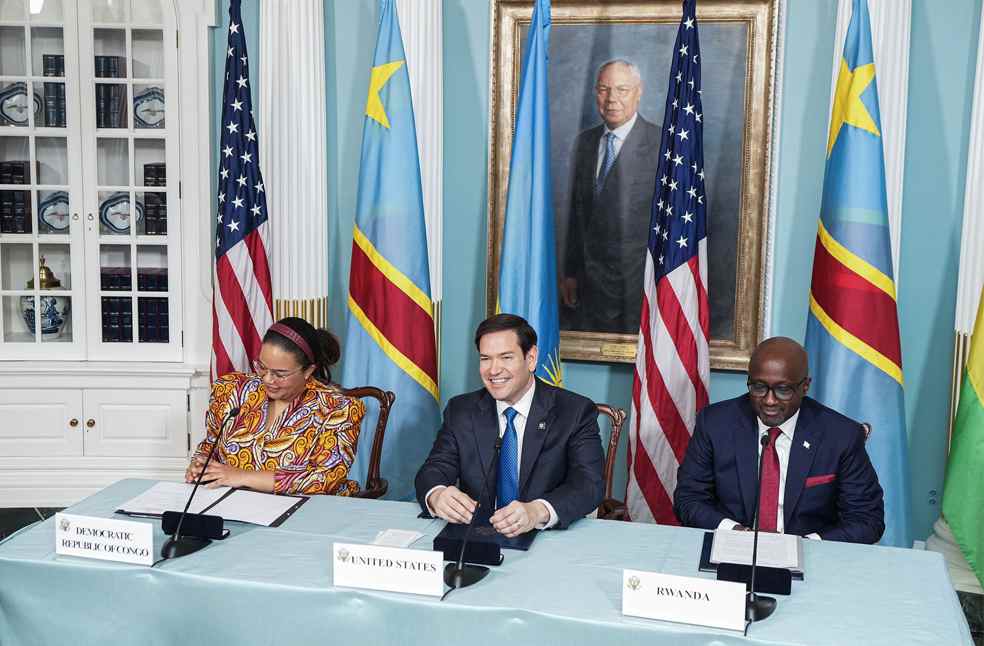
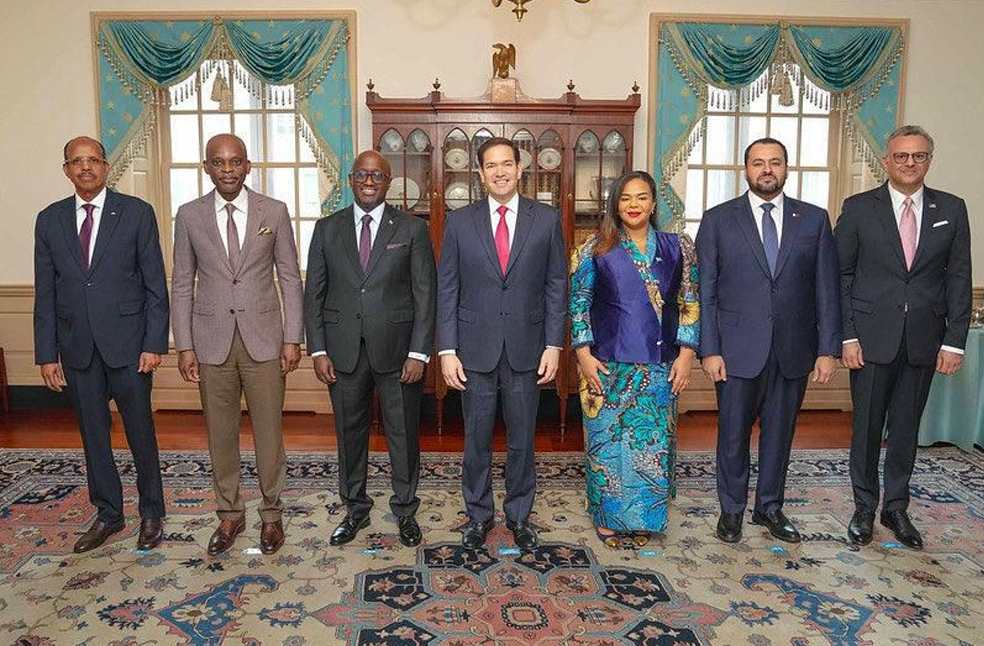
The treaty follows a ‘Declaration of Principles’ signed on April 25 in Washington DC by US Secretary of State Marco Rubio, Rwandan Foreign Minister Olivier Nduhungirehe, and DR Congo Foreign Minister Thérèse Kayikwamba Wagner, during a ceremony at the US State Department.
President Trump welcomed the Foreign Ministers of Rwanda and the Democratic Republic of Congo to the Oval Office to sign a historic peace agreement, ending a 30-year conflict.
"Today, the violence & destruction come to an end, & the entire region begins a new chapter of hope." pic.twitter.com/20P2SMBQiR
— The White House (@WhiteHouse) June 27, 2025
The official signing was attended by the US President Donald Trump, Vice-President JD Vance, Secretary Rubio, and delegates from both African nations.
In a celebratory speech in the Oval Office, President Trump hailed the accord as ‘a glorious triumph’ and ‘a tremendous breakthrough,’ emphasizing that the signing marked the end of destruction and the start of a new chapter of “hope and opportunity” for the region.
The foreign ministers of both Rwanda and DR Congo formally signed the Peace Deal at the US State Department, before Trump added his signature during the Oval Office event. The Congolese presidency described the deal as ‘another diplomatic success for President Félix Tshisekedi, certainly the most important in over 30 years.’
There is speculation that Presidents Tshisekedi and Paul Kagame of Rwanda may soon travel to Washington together to meet Trump, though no date has been confirmed.
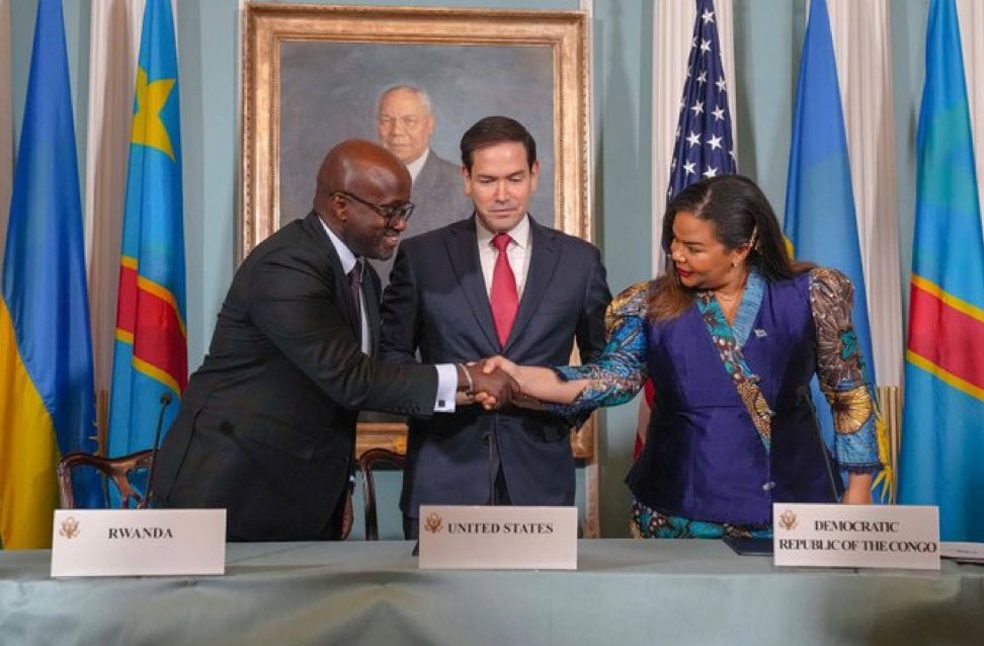
The signing follows a major diplomatic push that included Qatari mediation earlier this year. When tensions between Rwanda and DR Congo surged in early 2025, Qatar dispatched envoys to both capitals and hosted a high-level meeting between Kagame and Tshisekedi in Doha. This led to the creation of a joint committee, with backing from the US, to maintain dialogue and reduce hostilities.
Background of conflicts
The conflict in eastern DR Congo intensified this year when M23 rebels, widely believed to be supported by Rwanda, seized control of vast areas including Goma, Bukavu, and two major airports. This offensive resulted in the deaths of thousands and the displacement of hundreds of thousands of civilians.
Amid heavy territorial losses, the Congolese government turned to the US for assistance, reportedly offering access to vital minerals, such as coltan, a rare and essential component in electronics, in return for security guarantees.
Rwanda denies supporting M23, despite mounting evidence, and maintains that its military presence in DR Congo is defensive, aimed at countering threats from the FDLR (Democratic Forces for the Liberation of Rwanda), a militia largely composed of ethnic Hutus linked to the 1994 Rwandan genocide. Kigali accuses DR Congo of supporting the FDLR, a charge Kinshasa denies.
Peace deal calls for integrity
The current peace deal refers broadly to ‘respect for territorial integrity’, ‘a prohibition on hostilities’, and the ‘facilitation of the return of refugees and internally displaced persons’, though it omits specific enforcement mechanisms.
Just a day before the signing, Rwandan Foreign Minister Olivier Nduhungirehe condemned a leaked draft of the agreement, emphasizing that the final document did not include the terms ‘Rwandan troops,’ ‘withdrawal,’ or ‘Rwanda Defense Force.’
Nevertheless, President Tshisekedi’s office stated that the agreement does call for troop withdrawal under the term ‘disengagement,’ which is broader and more diplomatically flexible.
Rwanda, for its part, insists that any ‘lifting of defensive measures in our border area’ would be contingent on the neutralization of the FDLR, reinforcing that the group remains a top concern for Kigali.
Unresolved questions
Despite the symbolic nature of the peace deal, key questions remain unanswered:
- Will M23 rebels vacate the territories they now control?
- Does ‘disengagement’ equate to a formal withdrawal of Rwandan troops?
- Will the return of refugees include the safe repatriation of thousands of Congolese currently in Rwanda?
- What does ‘disarmament’ mean in practical terms for M23 and the FDLR?
- Who will carry out or oversee the disarmament process after previous failures?
- Will humanitarian access include reopening rebel-held airports for aid supplies?
One major concern is that M23 itself emerged from a failed peace agreement 16 years ago that never delivered on disarmament and reintegration.
Attempts to find a lasting solution have previously faltered. Last year, under Angolan mediation, Rwandan and Congolese delegations reached agreements on troop withdrawal and joint operations against the FDLR twice, but ministers from both sides failed to endorse the documents. Angola ultimately withdrew as a mediator in March 2025.
As the region cautiously welcomes the news of this latest agreement, the durability of the peace will hinge on the clarity of its terms, the commitment of both sides, and the sustained involvement of international guarantors like the US and Qatar.
ALSO READ | EU proposes law for two free cabin bags on flights
