


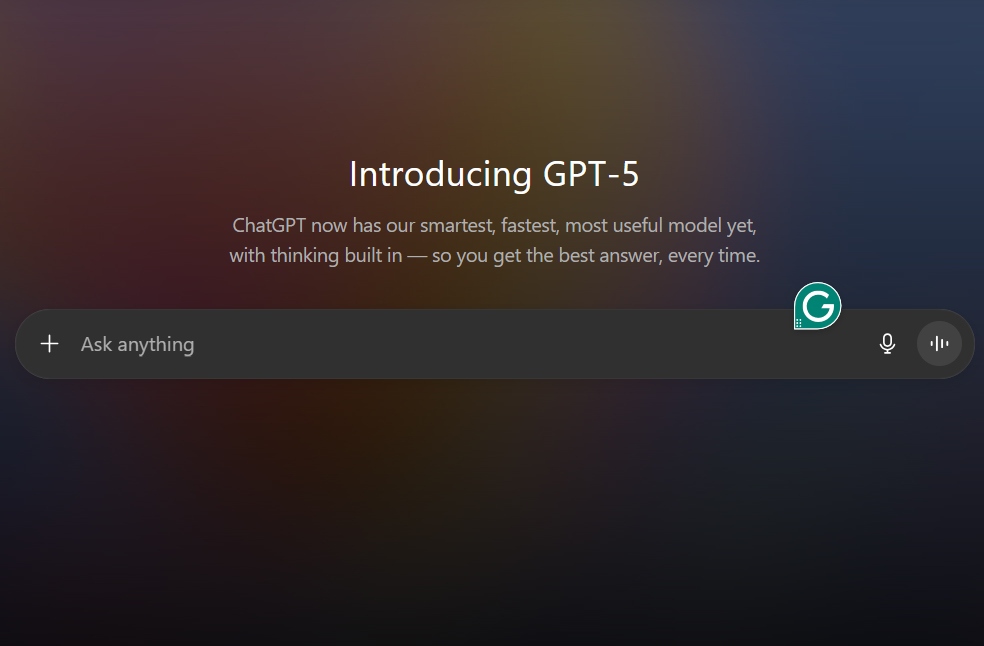
San Francisco: OpenAI has unveiled GPT-5, the highly anticipated new version of its ChatGPT artificial intelligence chatbot, promoting it as ‘smarter, faster, and more useful’ with PhD-level expertise across a range of subjects.
Co-founder and CEO Sam Altman described the model as marking a new era for ChatGPT, and remarked that, “Having something like GPT-5 would be pretty much unimaginable at any previous time in human history.”
The rollout began on August 7, for all users, with OpenAI claiming the model excels in coding, writing, and complex reasoning, while producing fewer ‘hallucinations,’ instances where AI generates inaccurate or fabricated information, and behaving less deceptively.
GPT-5 is here.
Rolling out to everyone starting today.https://t.co/rOcZ8J2btI pic.twitter.com/dk6zLTe04s
— OpenAI (@OpenAI) August 7, 2025
GPT-5’s capabilities and features
Billed as a major leap forward, GPT-5 can reportedly create complete software applications, explain its logic step-by-step, and provide more honest, accurate, and human-like responses.
Altman compared its evolution to past releases, and highlighted that, “GPT-3 sort of felt to me like talking to a high school student… 4 felt like you’re kind of talking to a college student. GPT-5 is the first time that it really feels like talking to an expert in any topic, like a PhD-level expert.”
The launch arrives amid fierce competition in the AI industry. Elon Musk, promoting his Grok AI chatbot integrated into X, recently claimed it is ‘better than PhD level in everything’ and ‘the world’s smartest AI.’
Rival Anthropic, developer of Claude AI, recently revoked OpenAI’s API access, alleging violations of its terms of service by using Anthropic’s coding tools in preparation for GPT-5.
OpenAI responded by saying it is ‘industry standard’ to evaluate other AI systems for safety and benchmarking, calling Anthropic’s decision ‘disappointing’ but noting that Anthropic still has access to OpenAI’s API.
While OpenAI hails GPT-5 as a breakthrough, some experts remain sceptical. Professor Carissa Véliz of the Institute for Ethics in AI argued that AI companies may be inflating capabilities to maintain momentum in a competitive market, warning these systems can only mimic, not truly replicate, human reasoning.
“As these models become more capable, the need for comprehensive regulation becomes even more urgent,” said Gaia Marcus, Director of the Ada Lovelace Institute.
Changes to ChatGPT
OpenAI has also announced new ChatGPT guidelines aimed at fostering healthier relationships between the AI and users, particularly for those experiencing emotional distress.
The chatbot will no longer provide definitive answers to personal questions, such as whether someone should end a relationship, instead helping users consider pros and cons. This shift follows a controversial May 2024 update that made ChatGPT ‘overly flattering,’ which was later rolled back.
Altman acknowledged that some people may develop problematic parasocial relationships with AI, citing the need for societal guardrails even as the benefits grow. The CEO has previously expressed admiration for the 2013 film Her, in which a man develops a relationship with an AI voiced by Scarlett Johansson. In 2024, Johansson accused OpenAI of using a voice ‘eerily similar’ to hers in a chatbot, leaving her ‘shocked’ and ‘angered.’
The GPT-5 release also introduces a free access tier, hinting at a potential shift away from OpenAI’s past reliance on fully proprietary models. As the technology rolls out worldwide, the coming days will determine whether GPT-5 delivers on Altman’s promise of a true PhD-level AI or represents a more incremental step in AI’s continuing evolution.
ALSO READ | FDA approves Modeyso for rare pediatric brain tumor
