


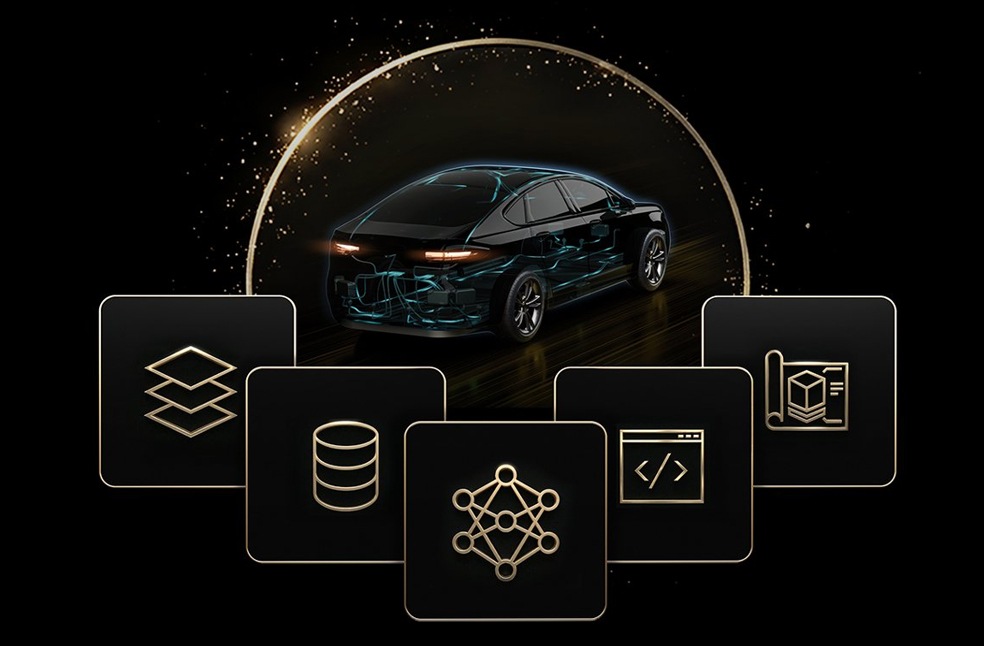
Las Vegas: NVIDIA Chief Executive Jensen Huang unveiled Alpamayo, a new technology platform designed to help autonomous vehicles reason and make decisions in a more human-like way. Huang announced the platform during his keynote address at the annual Consumer Electronics Show (CES) in Las Vegas.
According to Huang, Alpamayo introduces advanced reasoning capabilities to self-driving cars, enabling them to navigate rare and unpredictable scenarios, operate safely in complex environments, and clearly explain the decisions they make while driving.
During the presentation, Huang also revealed that NVIDIA has begun producing a driverless Mercedes-Benz CLA powered by its technology, developed in partnership with the German automaker. The vehicle is expected to launch in the United States in the coming months, before expanding to Europe and Asia.
Wearing his trademark black leather jacket, Huang told an audience of hundreds that working on the project has taught NVIDIA ‘an enormous amount’ about how to support partners in building advanced robotic systems.
NVIDIA’s share at a hike
Analysts stated that the announcement further reinforces NVIDIA’s leadership in integrating AI hardware and software, while strengthening its push into the field of physical AI.
Paolo Pescatore, an analyst at PP Foresight speaking from Las Vegas, highlighted that NVIDIA’s focus on AI at scale and AI systems as key differentiators would keep the company well ahead of its rivals. Pescatore described Alpamayo as a significant shift for NVIDIA, transforming it from a company primarily known for computing into a platform provider for physical AI ecosystems.
NVIDIA’s shares rose slightly in after-hours trading following Huang’s presentation. The keynote featured a video demonstration showing an AI-powered Mercedes-Benz driving through San Francisco, while a passenger sat behind the steering wheel with their hands resting in their lap.
Huang said that the vehicle drives naturally because it was trained directly using human driving demonstrations. The CEO added that in every scenario, the system explains what it plans to do and reasons through its actions before executing them.
Alpamayo has been released as an open-source AI model, with its underlying code now available on the machine-learning platform Hugging Face. The CEO said that autonomous vehicle researchers can access the model for free and retrain it for their own use.
Outlining NVIDIA’s long-term vision, Huang noted that the company believes that one day every car and truck will be autonomous. The project could increase competition for companies such as Tesla, which offers driver-assistance software through its Autopilot system.
Like Tesla, NVIDIA has also announced plans to launch a robotaxi service next year in partnership with another company, though it has declined to identify the partner or disclose where the service will operate.
NVIDIA remains the world’s most valuable publicly traded company, with a market capitalisation exceeding $4.5 trillion (£3.3 trillion). The company briefly became the first to reach a $5 trillion valuation in October, though its shares have since faced pressure amid concerns that demand for AI technology may be overhyped.
In addition, NVIDIA revealed that its highly anticipated Rubin AI chips are currently being manufactured and are scheduled for release later this year. The next-generation chips are expected to deliver powerful computing performance while consuming less energy, potentially lowering the cost of developing AI technology.
MOST READ | UK faces outcry over plan to search asylum seekers’ phones
