


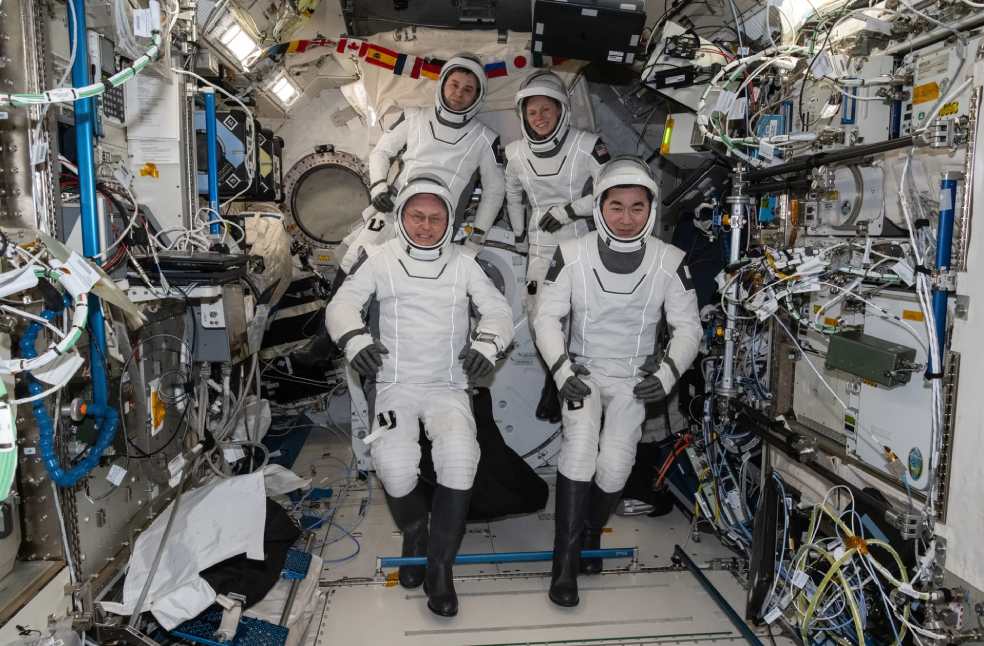
United States: Four astronauts have departed the International Space Station (ISS) nearly a month ahead of schedule, marking the first medical evacuation from the orbiting labouratory since it began operations in 1998.
NASA confirmed that Crew 11 undocked from the station following a medical issue involving one astronaut. While the agency has not disclosed the identity of the individual or the nature of the illness, it stated the crew member is in stable condition and receiving appropriate care. The spacecraft is expected to splash down off the coast of California.
The returning crew includes NASA astronauts Mike Fincke and Zena Cardman, Japan Aerospace Exploration Agency (JAXA) astronaut Kimiya Yui, and Russian cosmonaut Oleg Platonov. They arrived at the ISS on August 1 and were originally scheduled to remain in orbit until mid-February.
LIVE: As Crew-11 concludes its mission earlier than planned, watch as its four crew members enter their @SpaceX Dragon spacecraft prior to undocking. Hatch closure is scheduled for 3:30pm ET (2030 UTC). https://t.co/rFCNTNu90r
— NASA (@NASA) January 14, 2026
Concerns first emerged when a planned spacewalk involving Fincke and Cardman was abruptly cancelled. Hours later, NASA acknowledged that one crew member had fallen ill, prompting medical evaluations and the decision to bring the team home early.
“It’s bittersweet,” Fincke said during the official change-of-command ceremony, as leadership of the ISS was handed over to Russian cosmonaut Sergey Kud-Sverchkov. In a subsequent social media post, he reassured the public that all crew members were stable, safe, and well cared for.
With the early departure, the ISS is now operating with a reduced crew of three: NASA astronaut Chris Williams and Russian cosmonauts Sergey Kud-Sverchkov and Sergei Mikaev. The station will remain understaffed until the next crew rotation arrives in February.
Despite the circumstances, Kud-Sverchkov expressed confidence in the team’s ability to maintain operations. Kud-Sverchkov stated that, “We will continue performing all scientific and maintenance tasks onboard, whatever happens.”
The ISS orbits Earth at an altitude of about 250 miles, completing 16 orbits daily at speeds exceeding 17,500 miles per hour. It is jointly operated by five international space agencies and serves as a critical platform for scientific research into microgravity and its effects on humans, plants, and animals.
While astronauts receive medical training and the station is equipped for minor health issues, there is no physician permanently stationed onboard. The incident highlights the growing concern among experts that future long-duration missions, including planned journeys to the Moon and Mars, as well as the rise of space tourism will require dedicated medical professionals to be part of flight crews.
Although unprecedented for the ISS itself, early mission terminations due to health concerns have occurred before in spaceflight history. Soviet cosmonauts returned early from missions in 1985 and 1987 due to serious medical conditions, underscoring the ongoing risks of human space exploration.
MOST READ | Scientist reports 1st direct signal of dark matter
