


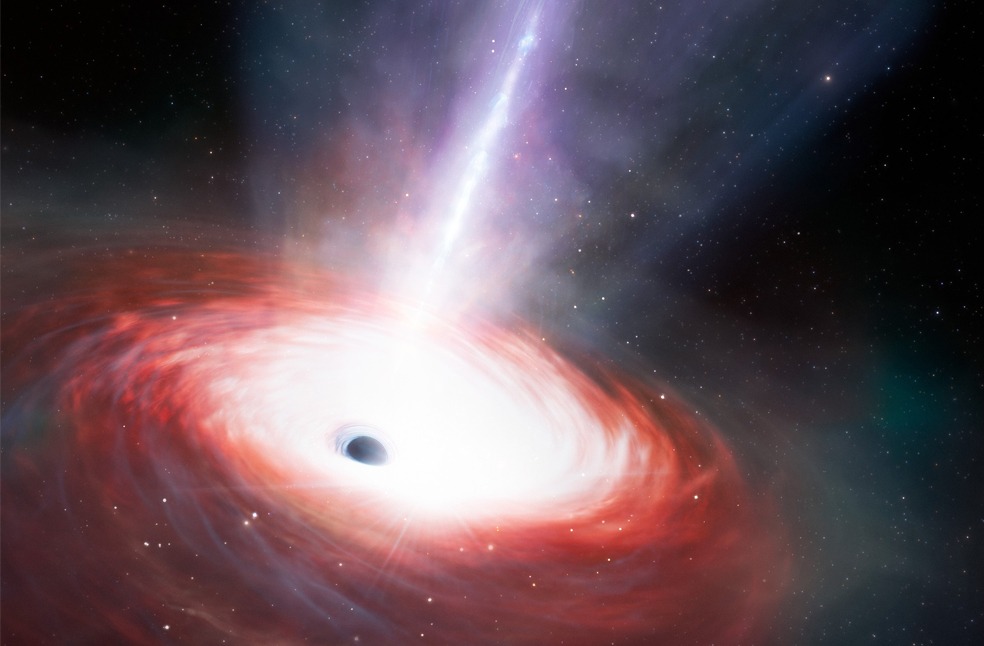
Chile: Astronomers have reported that some supermassive black holes may not be as enormous as previously assumed. Following a breakthrough study of a distant quasar, an intensely bright, active core of a galaxy, researchers discovered that the black hole at its centre has a mass of roughly one billion times that of the Sun, which is only about one-tenth of prior estimates.
A team from the University of Southampton, collaborating with European colleagues, observed the galaxy located more than 12 billion light-years away using advanced instruments at the European Southern Observatory (ESO) in Chile.
“Despite the quasar’s extreme luminosity, the black hole at its heart was found to have a mass equal to ‘only’ around one billion suns,” said Associate Professor Christian Wolf of the Australian National University (ANU) to ANU Reporter.
Prof. Wolf noted that instead of spinning rapidly as expected, the black hole was ‘belching up’ gas, driven outward by the blinding intensity of light. The black hole at the centre of this young galaxy was first detected in 2024 by Wolf and his colleagues at ANU.
Path to solving mysteries
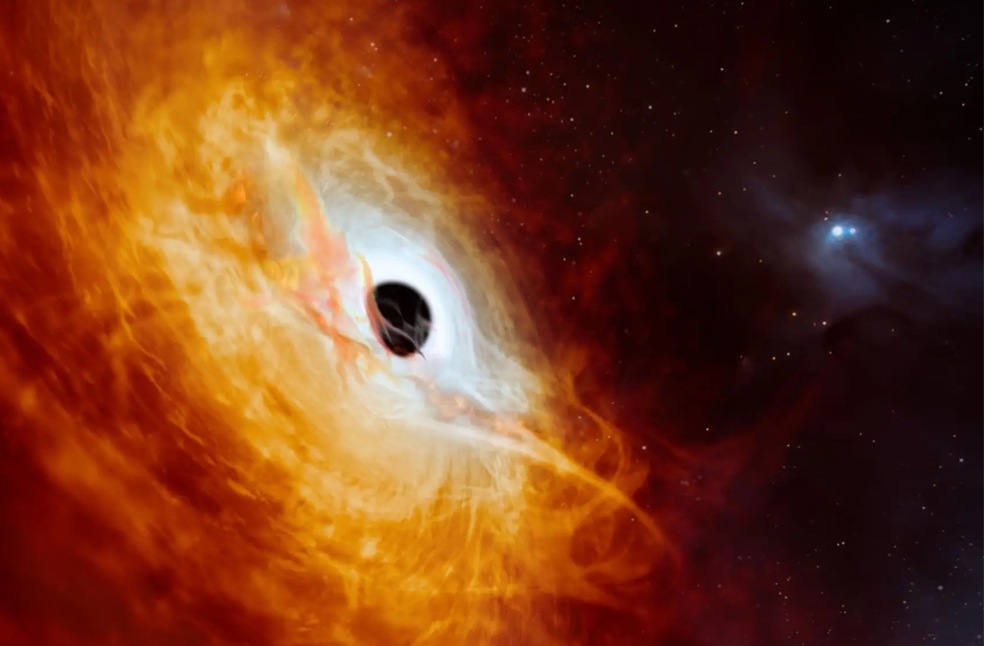
Professor Seb Hoenig of the University of Southampton explained that the discovery helps solve a long-standing mystery, “We have been wondering for years how it’s possible we discovered all these fully grown supermassive black holes in very young galaxies shortly after the Big Bang. They shouldn’t have had the time to grow that massive,” Prof Hoenig remarked.
The study, published in Astronomy and Astrophysics, utilised Gravity+, an instrument that combines light from four of ESO’s Very Large Telescopes in Chile. The research team, which included scientists from France, Germany, Portugal, and Belgium, analysed the hot gas spiralling into the black hole.
Their findings indicate that the intense radiation surrounding the black hole blasts away most of the incoming gas, preventing it from accumulating mass as quickly as previously assumed.
This discovery about the black hole may lead scientists to reconsider the methods used to measure black holes and could reshape models of cosmic evolution, challenging previous assumptions about how quickly black holes can grow in the early universe.
MOST READ | Hong Kong braces for destructive Super Typhoon Ragasa
