



London: Thousands of writers, including Kazuo Ishiguro, Philippa Gregory, and Richard Osman, have released an unusual ‘empty’ book to protest against artificial intelligence companies using their works without permission.
The publication, titled ‘Don’t Steal This Book,’ contains no written content apart from a list of the names of around 10,000 contributing authors. Copies are being distributed to attendees at the London Book Fair, shortly before the UK government is scheduled to release an economic assessment of proposed changes to copyright law affecting creative industries.
Under the current timeline, ministers must deliver an economic impact assessment by March 18, along with a progress update on a consultation exploring possible reforms to the country’s copyright framework. The proposed legal changes have sparked widespread concern among writers, artists, and other creative professionals who fear their work could be used by AI companies without permission or compensation.
The protest initiative was organised by composer and campaigner Ed Newton-Rex, who has been advocating for stronger copyright protections for artists and creators. The campaign highlights concerns that generative AI systems are trained using large amounts of data, including copyrighted material collected from the open web, to develop technologies such as chatbots and image generators.
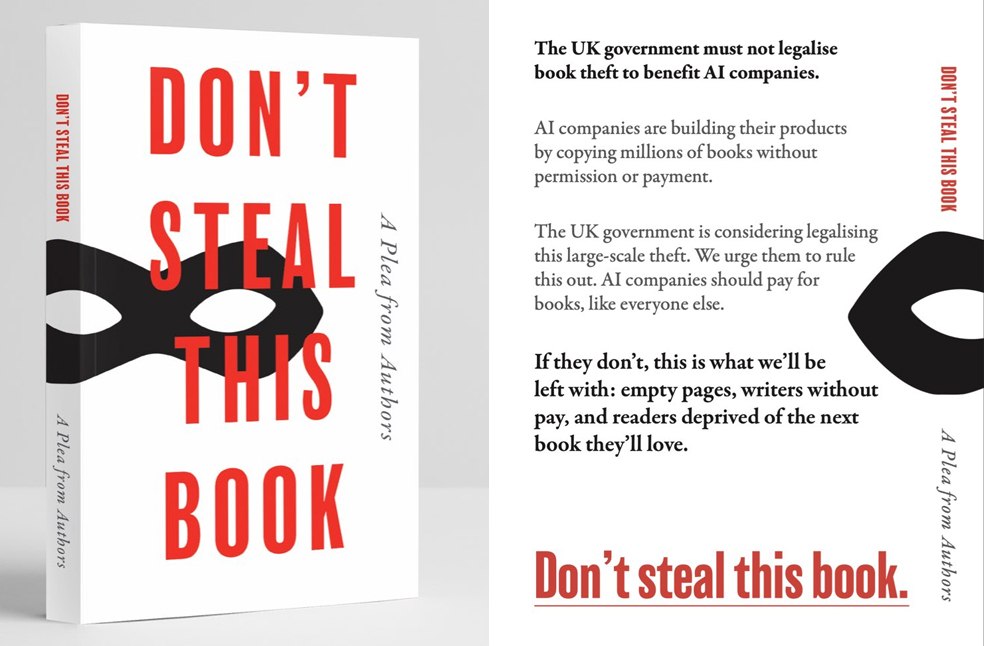
A number of prominent authors have supported the initiative by contributing their names to the publication, including Mick Herron, creator of the Slow Horses series; novelist Marian Keyes; historian David Olusoga; and writer Malorie Blackman, author of Noughts and Crosses. The book’s back cover carries a message urging the UK government not to legalise the use of books for AI training without permission.
Publishers are also preparing to introduce an AI licensing initiative during the London Book Fair. Publishers’ Licensing Services, a non-profit industry body, is establishing a collective licensing scheme and inviting publishers and rights holders to participate. The initiative aims to provide a legal framework that allows AI companies to access published works through licensing agreements.
Artificial intelligence systems require vast amounts of training data, and developers often collect material from publicly accessible sources on the internet, including copyrighted content. This practice has raised concerns among creative industries worldwide and has resulted in multiple legal disputes across Europe and North America.
One high-profile case involved AI company Anthropic, the developer of the Claude chatbot, which last year agreed to pay $1.5 billion (£1.1 billion) to settle a class-action lawsuit filed by authors who alleged that pirated copies of their books had been used to train the company’s AI system.

In the UK, artists and creators have strongly criticised the government’s main proposal under consultation. The plan would allow AI companies to use copyrighted material unless the rights holder explicitly opts out. Among those voicing opposition to the proposal is musician Elton John, who has publicly criticised the suggested changes.
Alongside the main proposal, the government has outlined three additional options: maintaining the current system, requiring AI companies to obtain licences before using copyrighted works, or allowing AI firms to use such material without providing an opt-out option for creators.
Officials have also not ruled out introducing a copyright waiver for material used in ‘commercial research,’ a possibility that many creative professionals believe could allow AI companies to access artists’ work without permission.
A government spokesperson said that the goal is to establish a copyright system that protects human creativity while supporting innovation. The government also confirmed it will continue engaging with the creative sector and provide an update to parliament by March 18.
KNOWLEDGEABLE | Mojtaba Khamenei chosen as Iran’s new supreme leader
