


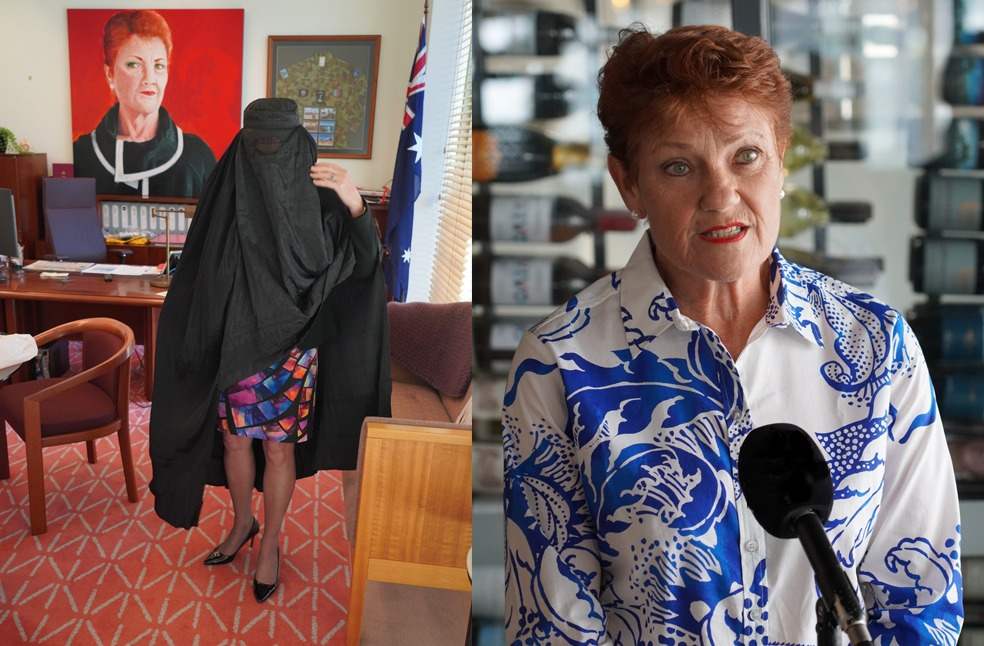
Sydney: A dispute centred on the burqa has resulted in Australia’s Senate suspending far-right Senator Pauline Hanson for seven sitting days after Hanson entered the chamber wearing a burqa as a political prop during a campaign to ban face coverings in public, an action that prompted strong criticism from representatives, including Muslim lawmakers.
The event took place after Hanson was denied permission to introduce legislation banning the burqa and other face coverings in public spaces. The choice to wear the garment during proceedings led to allegations of racism and disrespect, with several senators expressing concern about the impact on social cohesion.
Foreign Minister Penny Wong said that the display was harmful and undermined unity, adding that Hanson’s actions mocked a faith practised by nearly one million Australians. Wong said that the stunt had vilified an entire religious community and damaged Parliament’s standing.
Today I was suspended from parliament for 7 sitting days for trying to bring the concerns of Australians, my constituents, to the floor of the Senate.
Liberals, Nationals, Labor and the Greens are all fighting One Nation because we are the only party debating the issues they… pic.twitter.com/MGE6KltAFx
— Pauline Hanson 🇦🇺 (@PaulineHansonOz) November 25, 2025
A censure motion against Hanson passed 55–5, marking a rare rebuke of a sitting senator. One Nation, the political party Hanson leads, has grown its presence in the Senate to four seats after gaining two in the general election in May. Opinion polling has indicated a further rise in support for the party and its policies, which include restrictive immigration positions.
In public comments following the suspension, Hanson argued that no dress code exists for Parliament and compared restrictions on helmets in banks and other venues with the use of the burqa in public. Hanson stated that voters would judge the action and reaffirmed the intent to maintain a stance on banning Islamic clothing.
Hanson has represented Queensland in the Senate and has become a prominent political figure since the 1990s after opposing immigration from Asia and seeking tighter border controls. Campaigns against Islamic garments have been a recurring theme in her political career. The incident marks the second time Hanson has worn a burqa in Parliament, repeating a similar protest staged in 2017.
POPULAR | Cyclone Fina leaves thousands without power in Northern Territory
