



New Delhi: India’s annual budget has doubled down on manufacturing-led growth, with Finance Minister Nirmala Sitharaman outlining a reform-heavy roadmap aimed at accelerating economic expansion with a volatile global backdrop.
Presenting the budget for the next financial year, Sitharaman said the government will prioritise structural reforms in manufacturing, strengthen the financial sector, and increase investments in cutting-edge technologies such as artificial intelligence. The strategy is aimed at boosting growth, attracting private investment and creating jobs for millions entering the workforce each year.
The Modi government has long sought to raise manufacturing’s share of GDP from under 20 percent to 25 percent, a key target seen as critical for large-scale employment generation. The Indian economy is projected to grow 7.4 percent in the current fiscal year, with inflation expected to remain near 2 percent. The fiscal deficit for the year is estimated at 4.4 percent of GDP.
Manufacturing push across seven sectors
To stimulate demand and private investment, the government has already introduced consumption and income tax cuts, reformed labour laws and initiated steps to open up the tightly regulated nuclear power sector.
The new budget will focus on scaling up manufacturing across seven priority sectors: pharmaceuticals, semiconductors, rare earth magnets, chemicals, capital goods, textiles and sports goods. In addition, the government plans to revive 200 legacy industrial clusters to support regional manufacturing ecosystems.
Fiscal consolidation and borrowing plans
The government said it will reduce its debt-to-GDP ratio to 55.6 percent in the next fiscal year from 56.1 percent currently. From this year onward, debt-to-GDP will serve as the primary anchor for fiscal policy.
To meet this target, the fiscal deficit for the new financial year is projected at 4.3 percent of GDP, broadly in line with the current year. Gross market borrowing is pegged at 17.2 trillion rupees.
Equity markets were largely flat following the budget announcement. The benchmark Nifty 50 showed little movement, while stocks linked to electronics manufacturing, infrastructure, textiles and pharmaceuticals saw mild gains. The Nifty Pharma index rose 0.1 percent, and the infrastructure index advanced about 0.2 percent.
Next-generation reforms
Prime Minister Narendra Modi said India is shifting from long-standing challenges toward long-term solutions that provide predictability and build global trust. Speaking ahead of the government’s economic survey, he said growth for the fiscal year starting in April is expected to range between 6.8 percent and 7.2 percent.
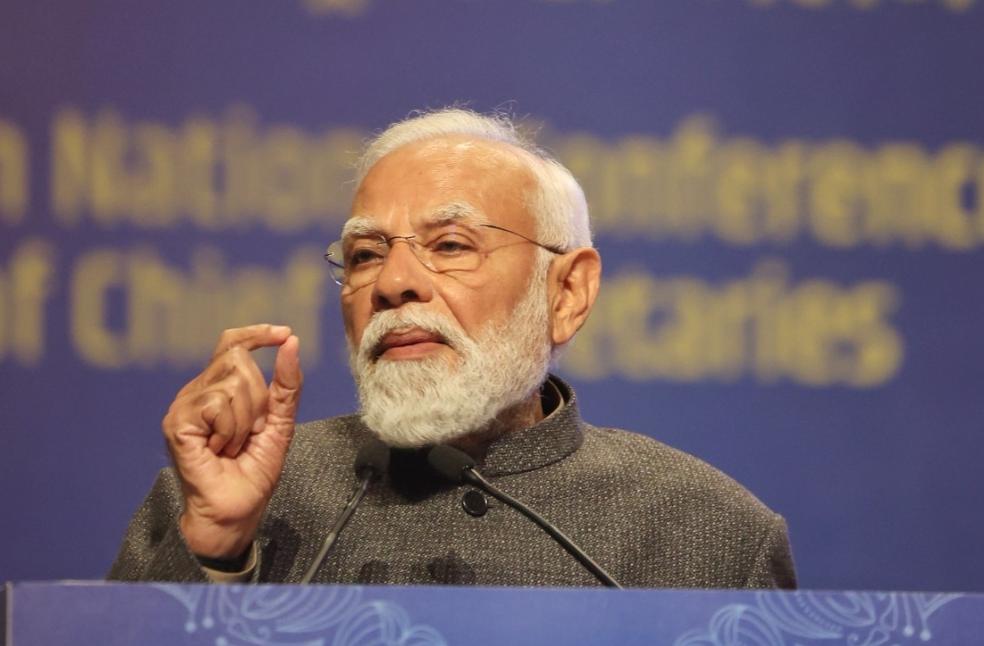
Modi said the next 25 years will be crucial for achieving India’s goal of becoming a developed economy, with next-generation reforms at the core of that journey.
India is also pursuing new trade agreements, including a landmark deal with the European Union, to cushion the impact of steep tariffs imposed by the United States on certain Indian exports.
Infrastructure and financial sector reforms
To sustain growth momentum, the government has allocated 12.2 trillion rupees for infrastructure spending in the coming year, up from 11.2 trillion rupees last year.
The budget also announced the formation of a high-level committee to review financial sector regulations. The review will cover non-banking financial companies and foreign investment rules, to make Indian markets more accessible to global investors.
In a push to deepen capital markets, the government unveiled measures to support the corporate bond market, including the introduction of total return swaps and incentives to boost fund-raising through municipal bonds.
Together, the budget measures signal a renewed focus on manufacturing, infrastructure and financial reforms as India seeks to sustain high growth and position itself as a resilient global economy.
TOP PICKS | SpaceX to launch 1mn satellites to power AI from orbit
