


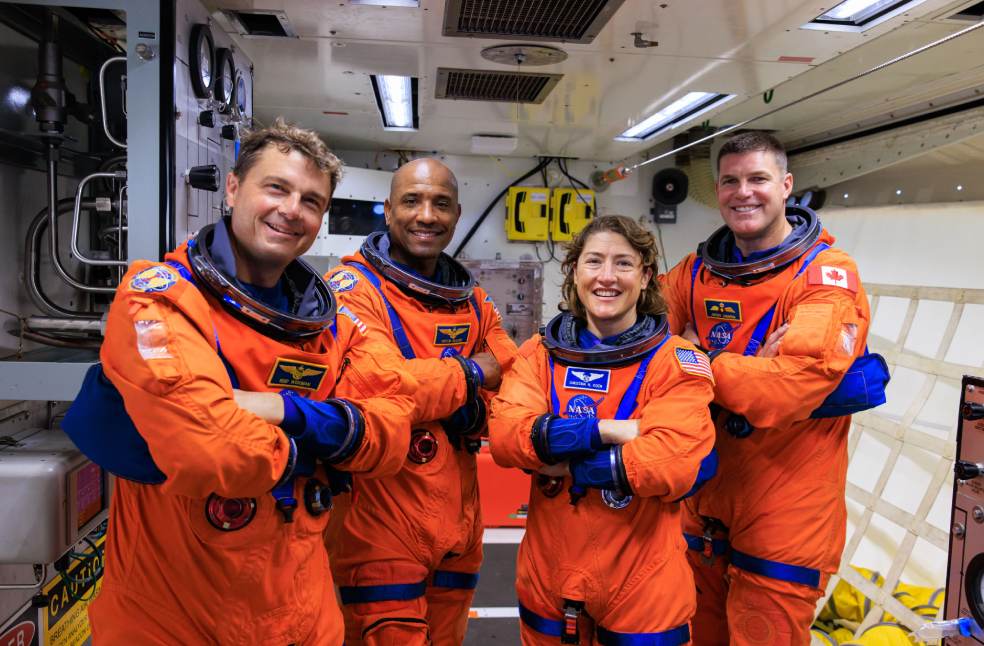
Florida: NASA has readied its most powerful rocket for the Artemis II mission that will carry astronauts on a round-the-Moon journey and back to Earth.
NASA has scheduled the launch from Kennedy Space Center in Florida as early as February 6, for a 685,000-mile round trip lasting about 10 days. The mission has marked the second flight of the Space Launch System rocket and the first time it will carry a human crew. The astronauts will live and work inside the Orion capsule while testing life-support, navigation and communications systems in deep space.
NASA has confirmed the crew will include Reid Wiseman, Victor Glover, Christina Koch and Canadian astronaut Jeremy Hansen. Koch has been set to become the first woman to travel beyond low Earth orbit, while Glover will become the first person of colour to do so. The mission will also mark humanity’s first journey around the Moon since Apollo 17 in 1972.
LIVE NOW: NASA experts give updates on the Artemis II mission before rollout of the Moon rocket and spacecraft to the launch pad. https://t.co/4YBQ33u19A
— NASA (@NASA) January 16, 2026
NASA has described Artemis II as a foundation for Artemis III, which has been planned to land astronauts near the Moon’s south pole as early as next year. The mission has also reflected growing international competition in lunar exploration, with renewed global interest in establishing a long-term human presence on the Moon. NASA has maintained that the Artemis programme is aimed at sustainable exploration rather than short-term achievements.
NASA has built the Space Launch System and Orion capsule to stand nearly 100 metres tall and produce enough thrust to reach speeds of up to 24,500 miles per hour. The rocket has carried more than enough liquid propellant to fill an Olympic-sized swimming pool, making it the most powerful launch system ever developed by the agency. These technical capabilities have been essential for deep space missions beyond low Earth orbit.
NASA has prepared crawler-transporter 2 to move the 5,000-tonne rocket from the vehicle assembly building to the launchpad, a journey that can take up to 12 hours. Engineers will then conduct a wet dress rehearsal by loading more than 700,000 gallons of propellant and running a full countdown simulation. These final tests have been designed to ensure the rocket systems can be fuelled, drained and operated safely before the historic mission.
POPULAR | Grok under investigation in California over AI deepfakes
