


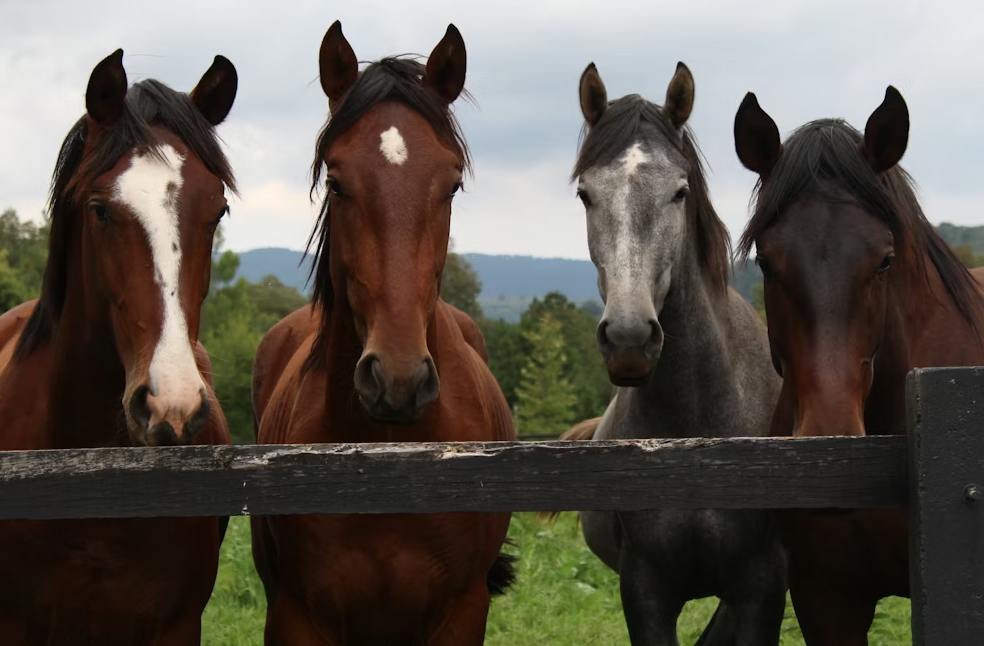
Paris: Horses have demonstrated the ability to sense fear in humans by detecting chemical changes in body odour, according to researchers who have examined how emotions can transfer between species.
The study has indicated that fear may be contagious between humans and horses, with volatile compounds in human sweat acting as warning signals of potential danger.
Researchers from the University of Tours in France have carried out a series of experiments to understand how horses respond to different emotional scents. Volunteers were asked to watch either frightening scenes from the horror film Sinister or joyful clips from films such as Singin’ in the Rain while wearing cotton pads under the arms to collect sweat samples.
These samples were then attached to the horses’ muzzles, positioned close to the nostrils, to allow the animals to smell the odours directly. The horses were observed during behavioural tests that measured their willingness to approach handlers, reaction to sudden events, and heart rate changes.
The results showed that when exposed to sweat collected from people watching frightening scenes, horses startled more easily, displayed higher heart rates, and were less inclined to approach or touch handlers. In contrast, exposure to sweat from people watching joyful scenes produced calmer behaviour and more frequent contact with handlers.

Dr Lea Lansade of the University of Tours said that, the study has demonstrated how closely connected animals and humans are, adding that emotions can be transmitted unconsciously and influence animal behaviour. The findings have reinforced the idea that smell plays a powerful role in communication, even across species boundaries.
Although cortisol levels, a biological indicator of stress, did not show measurable differences, behavioural and cardiovascular responses clearly reflected emotional sensitivity. The study has been published in the journal Plos One.
Dr Plotine Jardat, a researcher at the French Horse and Riding Institute, said that, riders and handlers should be aware that personal emotional states can affect horses. Jardat said that, arriving calm and relaxed encourages better interaction, while fear in humans can make horses more anxious and reactive.
Previous research has already shown that dogs and horses can detect human fear. Professor Biagio D’Aniello of the University of Naples Federico II said that, the new findings add to growing evidence that emotional communication can cross species boundaries through smell.
The research has raised important questions about how emotional wellbeing influences everyday human-horse interactions, from training environments to clinical and veterinary settings. Horses appear not only to respond to human actions but also to subtle emotional signals carried in scent.
TRENDING | Lifestyle tweaks of five minutes can improve life expectancy
