



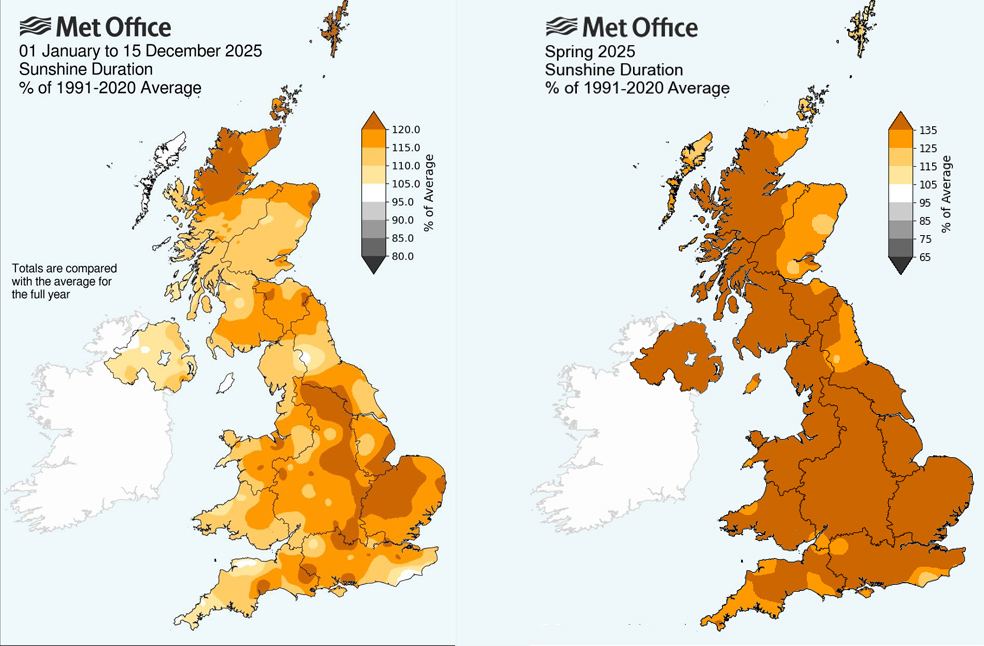
London: The UK has recorded its sunniest year on record in 2025, despite December not yet being complete, according to provisional figures from the Met Office. By December 15, the country had already logged 1,622 hours of sunshine, surpassing the previous record set in 2003.
This exceptional level of sunshine was largely driven by persistent high-pressure systems throughout the year, particularly during spring and summer. These weather patterns reduced cloud cover and delivered long stretches of clear, sunny days across much of the country.
Met Office senior scientist Mike Kendon described spring 2025 as ‘exceptional,’ marked by prolonged periods of almost uninterrupted sunshine. Kendon noted that only February and October saw below-average sunshine levels this year.
However, the sunshine was not evenly distributed. England experienced its sunniest year ever, while Scotland is on track for its second sunniest and Wales its sixth. Northern Ireland, although above average, is unlikely to rank in its top ten sunniest years.
Scientists say the UK has generally been getting sunnier since the 1980s, though the exact cause remains unclear. The Met Office suggests the trend could be due to natural variability. Others, such as Imperial College London’s Professor Edward Gryspeerdt, point to reduced air pollution following clean air legislation, which has lowered aerosol levels.
Fewer aerosols mean clouds reflect less sunlight, allowing more sunshine to reach the ground. There is “no definitive evidence” that climate change is impacting sunshine levels, according to the Met Office.
Solar energy comes in
The abundance of sunshine has had a major impact on renewable energy generation. Solar power reached record highs in 2025, producing 18 terawatt-hours of electricity by November, well above the 14 terawatt-hours generated by the end of 2024.

Professor John Marsham of Leeds University said that the surge in solar generation is helping reduce electricity prices by weakening the UK’s reliance on gas.
Research from energy thinktank Ember also highlights the reliability of renewables, noting that only 2 percent of days typically experience both low wind and low sunshine. This makes solar a strong complement to wind energy, which tends to generate more power during winter months.
Despite the benefits, large-scale solar farms have faced opposition in some communities due to concerns over landscape impact, including in parts of Lincolnshire where several projects were recently approved.
Craig Dyke from the UK’s National Energy System Operator (NESO) highlighted the scale of the country’s energy transition, noting that renewables now generate around 60 percent of Britain’s electricity, up from just 3 percent in 2000, underscoring how far the UK has come in a quarter of a century.
ALSO READ | National Highways flags camera error behind speeding fines
