



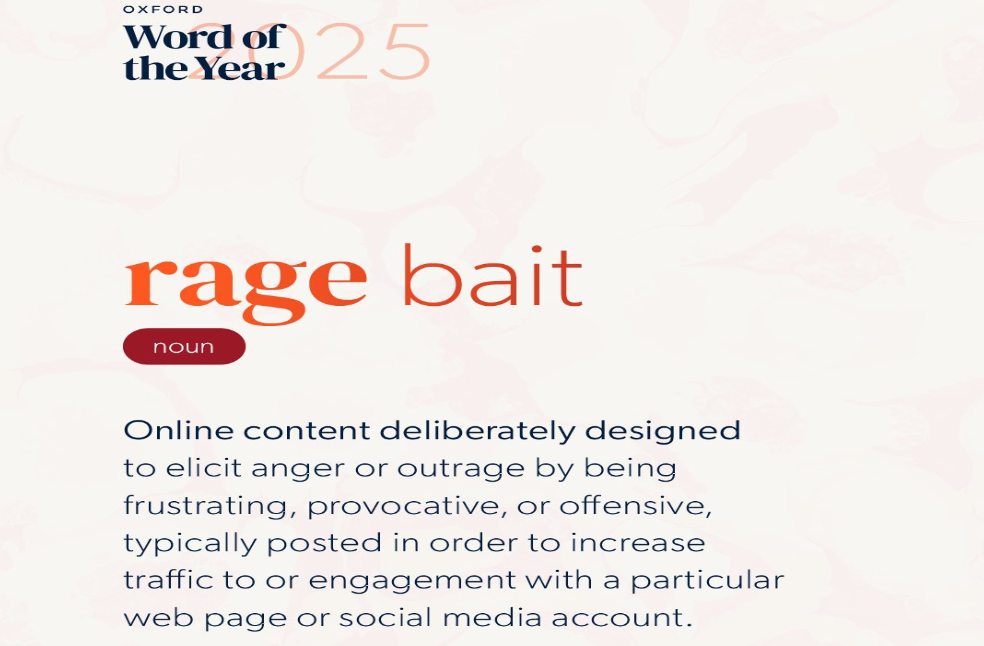
London: The Oxford word of 2025 has been announced as ‘rage bait’, a term describing online content designed to provoke anger or outrage.
Language experts have said that usage of the term has increased threefold over the past year, reflecting rising awareness of emotionally manipulative tactics across digital platforms. The shortlist for this year’s selection also included “aura farming” and ‘biohack’, but ‘rage bait’ has been chosen as the term that best captured public conversations and cultural shifts in 2025.
According to Oxford University Press, the publisher responsible for the Oxford English Dictionary, rage bait refers to posts or articles intentionally crafted to irritate or frustrate users, with the aim of boosting engagement.
The concept has been compared to clickbait, which uses enticing headlines to attract readership. However, rage bait is more specifically focused on eliciting anger. Oxford’s analysis has shown that such content has become widely used to drive traffic and influence online discussions, with creators using divisive topics, provocative framing or misleading narratives.
Oxford Language experts have said that the surge in rage bait demonstrates how digital engagement strategies have shifted from curiosity-driven clicks to emotional manipulation. Casper Grathwohl, president of Oxford Languages, has said that the trend reflects a wider conversation about how technology shapes behaviour and emotional responses.
The shortlisted terms have also highlighted broader cultural moments. ‘Aura farming’ has been described as a form of curated self-presentation intended to project confidence or mystique, while ‘biohack’ refers to efforts to enhance physical or mental performance through lifestyle changes, supplements or technology.
The rise of rage bait has been linked to concerns about online toxicity, misinformation and the psychological toll of digital consumption. Researchers have said that constant exposure to provocative content can contribute to mental fatigue and polarised discourse.
Last year’s word of the year, “brain rot”, captured the experience of mental overload associated with endless scrolling. Grathwohl has noted that both terms reflect fatigue with the online environment, where algorithms prioritise emotionally intense content and users find themselves pulled into cycles of reaction.
Past Oxford winners have included ‘selfie’, “goblin mode” and ‘rizz’, all of which sparked widespread discussion about language change and cultural trends. Other dictionary institutions have also announced their 2025 selections, with Cambridge choosing ‘parasocial’, referring to one-sided relationships between fans and public figures, and Collins selecting “vibe coding”, referring to AI-assisted app creation.
The selection underscores how language continues to evolve in response to technological shifts and the ways people interact online.
IMPORTANT | Scientists detect electrical activity on Mars for first time
