


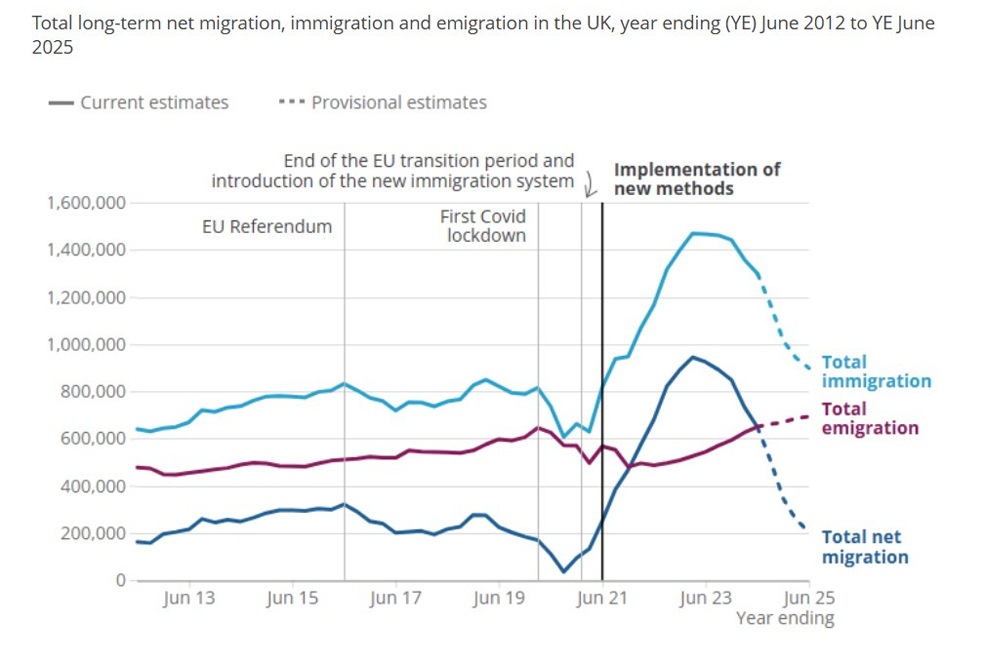
London: Provisional data from the Office for National Statistics (ONS) shows that net migration to the UK dropped by two-thirds in the year ending June 2025, compared with the previous 12-month period.
Net migration, defined as the difference between those entering and leaving the country, fell to 204,000, down from 649,000. The decline was largely driven by fewer people arriving for work and study.
At the same time, Home Office figures reveal that the number of people claiming asylum in the UK in the year to September 2025 climbed to a record 110,051 applications. The number of asylum seekers accommodated in hotels also increased by 2 percent compared with September 2024.
Net migration is at its lowest level in half a decade and has fallen by more than two-thirds under this government.
But we are going further – tackling the pressure that the pace and scale of migration has placed on local communities and ensuring those who come here contribute. pic.twitter.com/pNgTX2AHBw
— Shabana Mahmood MP (@ShabanaMahmood) November 27, 2025
These statistics come from two separate releases published:
- the ONS update covering net migration up to June 2025
- the Home Office update covering the immigration system up to September 2025
This is the first ONS migration dataset that reflects nearly all of Labour’s first year in government.
A graph released alongside the data shows net migration in the year to June 2025 at two-thirds lower than the previous year, with a blue line marking total arrivals and a red line indicating net migration trends from 1991 to June 2025.
The Home Office also reported that initial asylum decisions reached 133,502 in total, almost half of which (45 percent) were grants of protection. Decision-making has reached ‘historically high’ levels, and the number of cases waiting for an initial decision dropped 36 percent between September 2024 and September 2025, despite record numbers of asylum applications. However, there has been a growing backlog of appeals.
The government has pledged to end the use of asylum hotels before the end of this parliament. As of September 2025, more than 36,000 people were temporarily housed in hotels. This reflects a 13 percent rise over the last three months, but only a small 2 percent increase year-on-year, and remains lower than the September 2023 peak of 56,018.
A Home Office spokesperson said that fewer than 200 hotels remain in use and reiterated the government’s commitment ‘to close every single one,’ adding that efforts are underway to move people to military bases to relieve pressure on local communities. The spokesperson added that, “We are furious at the levels of illegal migrants and asylum seekers.”
Small boat arrivals increased significantly, up 53 percent compared with the previous year, with 45,659 people crossing the English Channel in the 12 months to September 2025. This figure is close to the 2022 peak of 45,774. The Home Office noted that the increase corresponds with an increase in the average number of people per boat.
Among those who arrived, 5,151 children under 18 crossed the Channel and sought asylum, including 2,700 accompanied minors. A spokesperson for the prime minister acknowledged the government “accepts that the number of small boat crossings is too high.”
Additional updates show that 153 migrants have been removed to France under the pilot ‘one in, one out’ scheme. A return flight included an individual removed on 16 October, who then re-entered the UK by small boat on 8 November, but was not counted twice. Meanwhile, 134 people have been transferred to the UK through this same programme.
The ONS emphasized that net migration figures include all long-term migrants, those changing their residence for 12 months or more, including people claiming asylum via regular and irregular routes. The sharp drop in arrivals also corresponds with a 70 percent fall in non-EU+ nationals coming on work and dependent study visas. (EU+ includes EU countries plus Norway, Iceland, Liechtenstein, and Switzerland.)
Responding to the numbers, Prime Minister Sir Keir Starmer noted that the reduction in net migration is ‘a step in the right direction.’ Home Secretary Shabana Mahmood highlighted that, net migration is now at its lowest in five years, highlighted that figures have dropped by more than two-thirds under the current government, and repeated her claim that new measures will ensure that migrants “contribute and put in more than they take out.”
Shadow Home Secretary Chris Philp argued the fall was driven by Conservative policies but insisted more must be done. Reform UK’s Zia Yusuf criticised Labour’s approach, saying the figures demonstrate “Labour’s warped priorities.” Liberal Democrats’ Max Wilkinson noted that the government must address the rising number of small boat arrivals and the continued dependence on asylum hotels.
Earlier this month, Mahmood outlined reforms to the legal migration system, including proposed changes to how long it may take for some migrants to achieve settled status. Additional measures aimed at reducing illegal migration include proposed changes to how Article 8 of the European Convention on Human Rights (right to family life) is applied in immigration court cases.
Migration specialists say that the June 2025 net migration figures likely reflect earlier Conservative-era measures, including the June 2024 increase in the salary threshold.
ALSO READ | Australia targets AI ‘nudify’ platforms in safety crackdown
