


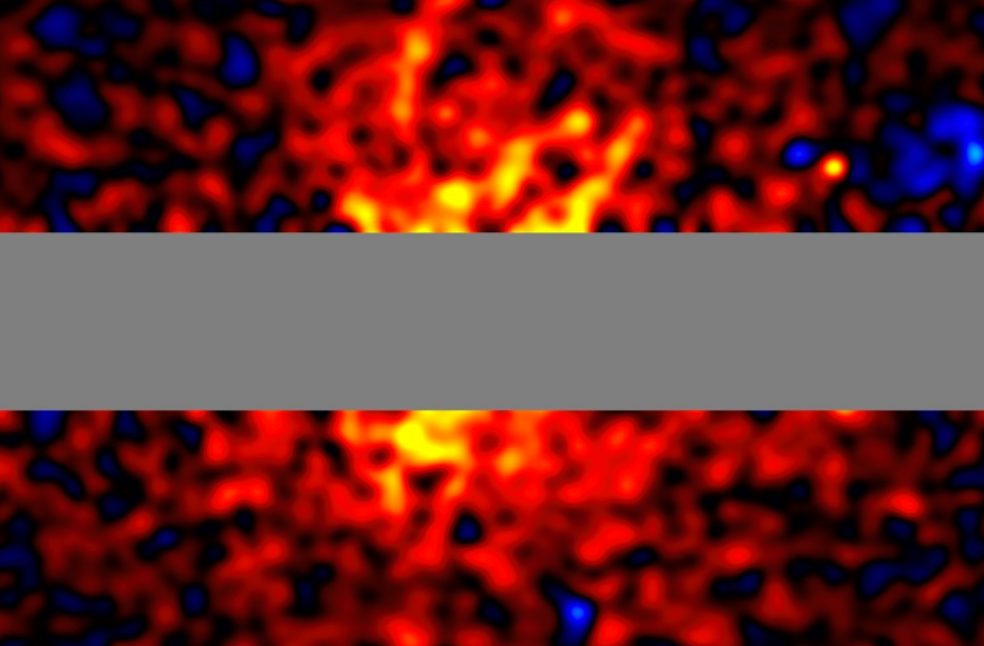
Japan: Nearly a century after the idea of dark matter was first proposed, a new study suggests researchers may have caught the elusive substance in action for the very first time.
The findings, while still tentative, could mark a defining moment in the decades-long search to understand what makes up more than a quarter of the universe. Prof. Tomonori Totani, an astrophysicist at the University of Tokyo, analysed data from NASA’s Fermi Gamma-ray Space Telescope and identified a pattern of high-energy gamma rays emerging from the centre of the Milky Way.
These gamma rays, Totani said, appear to align with the expected shape of the galaxy’s dark matter halo. Totani remarked that, “This could be a crucial breakthrough in unravelling the nature of dark matter,” noting that the signal closely resembles the radiation predicted when dark matter particles, often theorised as weakly interacting massive particles, or wimps, collide and annihilate each other.
Dark matter was first described in the 1930s, when Swiss astronomer Fritz Zwicky observed galaxies spinning faster than visible mass could explain. Scientists have since proposed that an invisible form of matter, which does not emit or absorb light, provides the gravitational pull holding galaxies together.

Yet despite decades of searches using underground detectors, space telescopes, and massive particle accelerators such as the Large Hadron Collider, direct detection has remained out of reach. Totani’s analysis, published in the Journal of Cosmology and Astroparticle Physics, suggests the signal could originate from particles roughly 500 times heavier than a proton.
However, the researcher emphasised that more work is needed to rule out alternative explanations, including other astrophysical processes occurring near the galactic centre. Other experts agree the findings are intriguing but far from conclusive.
Prof. Justin Read of the University of Surrey pointed out that similar gamma-ray signatures have not been observed in dwarf galaxies, regions where dark matter is thought to dominate, arguing that the absence of such evidence weighs heavily against the dark matter interpretation.
Prof. Kinwah Wu, a theoretical astrophysicist at UCL, also called for restraint. Kinwah Wu stated that, “We need extraordinary evidence for an extraordinary claim. This analysis has not reached this status yet, but it is an encouraging step for researchers in the field.”
As scientists continue to examine gamma-ray data from across the cosmos, the hope is that clearer signals may finally illuminate the true nature of dark matter, one of the universe’s most enduring mysteries.
MOST READ | MLB secures broadcast deals with Netflix, ESPN and NBCUniversal
