


Melbourne, Australia: About 26,000 households in south-east Queensland were without power on October 27 after a severe thunderstorm passed over the state, producing wind gusts of up to 109 km/h. Residents also reported giant hailstones, with sizes reaching up to 7 cm in some areas.
More than 1,300 energy customers in Victoria experienced outages following Melbourne’s wettest day in a year and a half, though most of these were resolved soon.
Energex, which supplies power to 1.5 million homes and businesses in south-east Queensland, said that the thunderstorm caused ‘significant damage,’ including downed wires across the greater Brisbane region. On the night of October 26, the company deployed nearly 70 crews to restore power.
Showers on and south of the ranges, tending to rain about East Gippland, easing later. Dry to the north. Cool and cloudy with below average day-time temps. Details: https://t.co/spelevacl3 pic.twitter.com/9SzE6hsNk1
— Bureau of Meteorology, Victoria (@BOM_Vic) October 26, 2025
On social media, Energex wrote that, “This afternoon’s thunderstorm has absolutely smashed our network! If you can see wires down, please stay well clear and call 000.”
The Bureau of Meteorology confirmed large hailstones in Queensland, with stones about 4 cm in Ipswich, 5 cm in Moorooka and Goonda, 5–6 cm in Pullenvale, and 7 cm in St Lucia. Severe winds were recorded in Amberley and Archerfield (95 km/h), and Gayndah (109 km/h). Lightning also interrupted Sunday’s Pacific Cup Men’s rugby league match between Samoa and Tonga in Brisbane, prompting spectators to seek shelter.
Damp conditions are expected to linger along much of eastern Queensland this week as a low-pressure trough continues to draw moisture toward the coast, with October 28 forecasted as the wettest day.
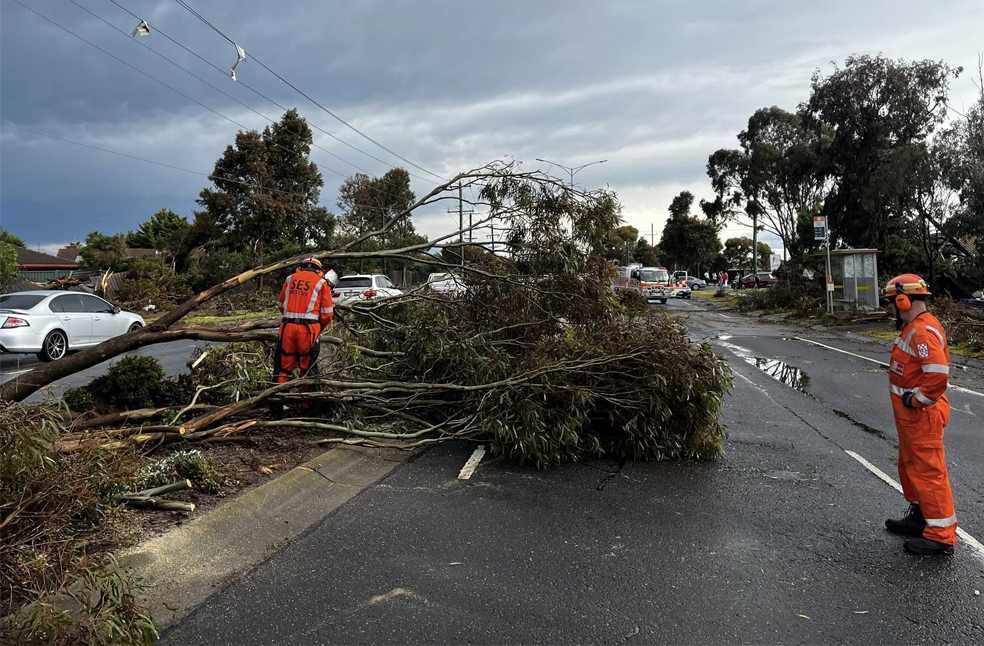
In Victoria, SES officials received 598 calls for assistance, mainly due to building damage, downed trees, and flooding. More than 100 calls remained active, the most affected suburbs were Werribee, Hoppers Crossing, and Wyndham, which collectively accounted for 179 requests for help.

At one point on October 26, more than 28,000 energy customers in Victoria were without power because of the thunderstorms. Melbourne also recorded heavy rainfall, with 35.4 mm falling in 24 hours at Melbourne Olympic Park, the most since April 2024.
A Bureau of Meteorology spokesperson noted that a ‘short-lived tornado’ may have affected parts of Melbourne’s western suburbs, including Wyndham Vale and Hoppers Crossing, though analysis is ongoing to confirm this.
Victorian Department of Health has warned of an increased risk of epidemic thunderstorm asthma in the northern country region. Melbourne experienced the world’s largest epidemic thunderstorm asthma event in November 2016, which overwhelmed emergency services and caused 10 deaths.
This severe weather highlights the combined threat of strong winds, hail, flooding, and potential tornadoes, leaving tens of thousands without power and prompting authorities to issue safety warnings.
ALSO READ | Work Anywhere: How remote work is redefining offices
